
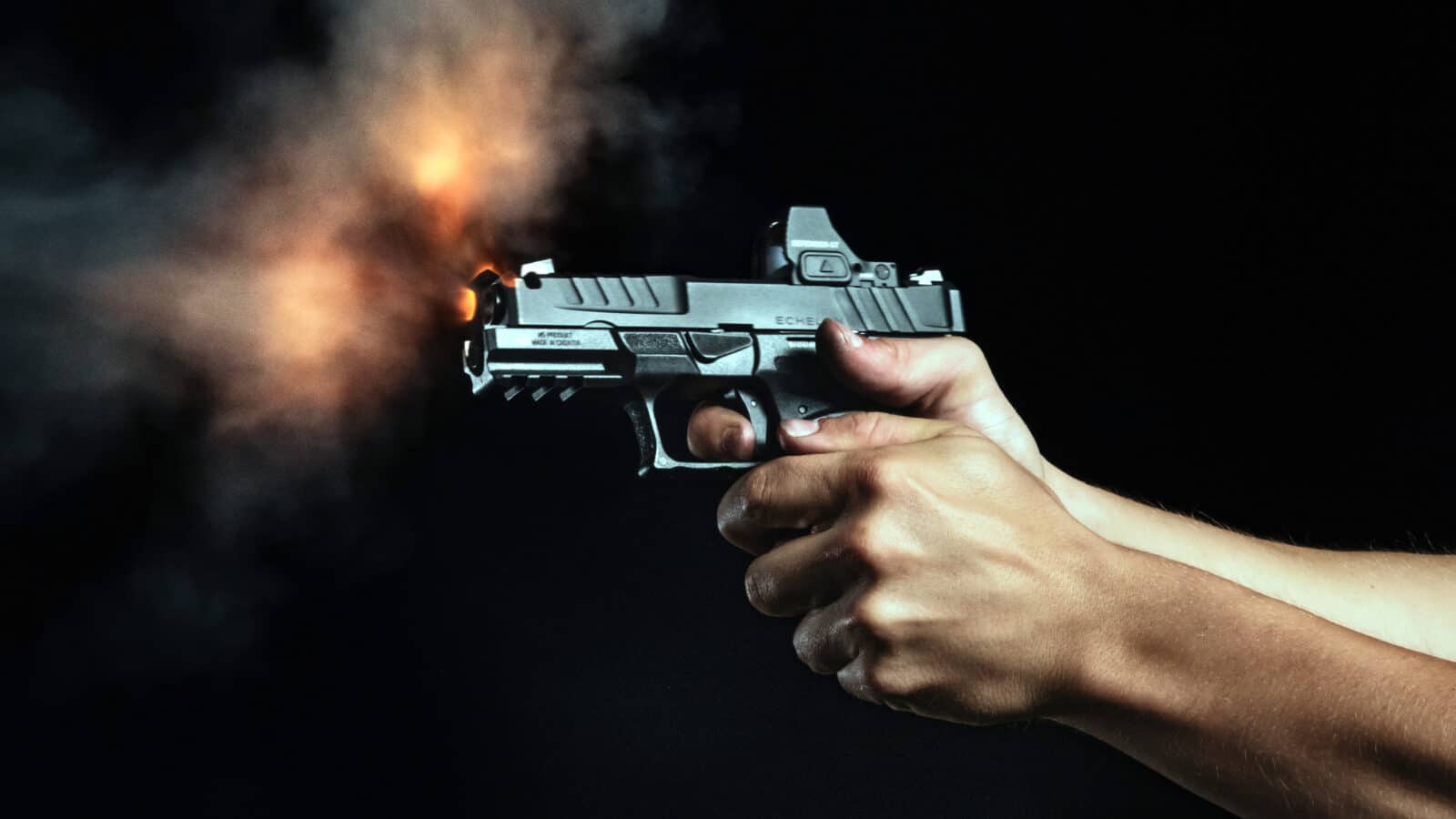
We need to talk about stopping power because there’s a lot of garbage floating around. Misinformation that might get you hurt. Or worse, make you overconfident in your carry gun’s ability to end a fight instantly.
Let me clear something up right now. Medical professionals experienced in evaluating gunshot wounds often cannot distinguish between wound paths from common handgun calibers during surgery or autopsy. That’s from the FBI’s own ballistic research. Not internet forum experts. Not gun shop commandos. Actual doctors.
So, when someone starts going on about how their .45 has “superior stopping power” to your 9mm? They’re likely selling you nostalgia, not facts.
Myth #1: Bigger Caliber Equals Better Stopping Power
This is probably the most persistent myth out there. Walk into any gun shop and you’ll hear it. “Real men carry .45 ACP.” “9mm won’t stop anyone.” “I carry a .45 ‘cause they don’t make a .46.”
Here’s the problem with that thinking.

Real-world incidents have documented people failing to stop attackers with .45 ACP while others have stopped threats with a single shot of .22 LR. I’ve read incident reports where subjects took multiple hits from .40 S&W and kept fighting. I’ve also seen documentation of .22 caliber rounds completely incapacitating someone. And, of course, I’ve seen plenty of cases where the bigger bullet did an excellent job.
The relationship between bullet size and immediate incapacitation isn’t linear or guaranteed.
What matters? Shot placement. Penetration depth. Whether you hit something the body absolutely needs to keep functioning.
The FBI spent years studying this after the 1986 Miami shootout. So have hundreds (thousands?) of other agencies, organizations and people. While theories vary, the majority of research supports the idea that the most effective way to stop an attacker with a handgun is to deliver multiple rounds quickly into vital areas.

Some rounds correlate with higher degrees of success. In general, popular handgun cartridges loaded with modern hollowpoint bullets — like the 9mm, .45 ACP, .40 S&W and .357 Magnum — all correlate with good performance when controlled for shot placement.
None of this is to say that the .45 ACP is ineffective. Quite the opposite — the .45 remains a solid choice for self-defense. However, your .45 doesn’t matter if you can’t hit vital structures. Practice and training remain a decisive factor.
Myth #2: Handguns Have Knockdown Power
This one comes straight from Hollywood. Bad guy gets shot. Bad guy flies backwards like he caught a fastball to the chest.
Except that’s not how physics works. The momentum of a .45 ACP bullet is not enough to physically knock down an adult who’s moving toward you.

If a bullet had enough energy to knock someone down? The recoil would knock you down, too. Conservation of momentum isn’t just a suggestion. It’s physics.
What actually happens when someone gets shot and goes down immediately? Usually one of two things. Either you hit their central nervous system and they physically cannot continue. Or, they choose to stop fighting because they’re injured, scared, or realize the situation has changed.
That second one? That’s psychological incapacitation and not physical knockdown power.
Even fatal wounds don’t guarantee instant stops. The body can keep functioning on residual oxygen in the blood. On adrenaline. On sheer determination.

Live The Armory Life. The latest content straight to your inbox plus an automatic entry to each of our monthly gun giveaways!
Only hits to the central nervous system are likely to cause immediate physical incapacitation. Everything else is penetration, blood loss, and time. Time you might not have.
This is why training emphasizes multiple shots. Why we practice failure drills. Why “shoot until the threat stops” is the standard guidance. Because handguns — all handguns — require good shot placement to work quickly.
Myth #3: Modern Hollow Points Guarantee Immediate Stops
Premium defensive ammunition has gotten incredibly good over the past three decades. Expansion is more reliable and penetration depth is more consistent. Barrier performance has improved dramatically.
However, good ammunition doesn’t equal guaranteed stops.

Here’s what modern hollow points do well: They penetrate to adequate depth (12-18 inches in ballistic gelatin) while expanding to create larger permanent wound channels. Compared to ball ammo, they’re less likely to overpenetrate and hit unintended targets. Compared to traditional, old school hollow points, they perform more consistently through barriers like clothing, drywall, or auto glass.
While great, the do not magically incapacitate attackers on contact.
Many people shot with handguns survive. That’s across all calibers and all bullet designs. Modern defensive rounds have absolutely improved our odds in self-defense situations, but they haven’t changed the fundamental reality that handguns are relatively weak tools compared to rifles or shotguns.

The FBI’s testing protocol revolutionized defensive ammunition evaluations. Ammunition must penetrate 12-18 inches through ballistic gelatin and various barriers to pass FBI standards. This gave us ammunition that works far better than what was available in the 1980s and earlier.
But “better” doesn’t mean “perfect.” It means your carry ammunition will likely perform as designed if you do your part. It means you have a fighting chance with proper shot placement.
The ammunition isn’t the weak link anymore. The shooter is.

What Actually Matters
If stopping power is mostly a myth, what should you focus on?
Shot placement. This is the single most important factor in defensive shooting effectiveness. Stopping power correlates more with shot placement than with any particular round. Hits to vital structures — heart, major blood vessels, lungs, central nervous system — are what end fights quickly.
Penetration. Your bullet needs to reach vital organs. That means adequate penetration through clothing, barriers, and tissue. Too shallow, and you’re poking holes without hitting anything critical. Too deep and you risk overpenetration.

Capacity. More rounds means more chances to get good hits. It means you can continue engaging if your first shots don’t work. It matters in multiple-attacker scenarios. Don’t sacrifice capacity for minimal gains in terminal ballistics.
Reliability. Your gun and ammunition need to work every single time. Malfunctions in a gunfight are catastrophic. Test your carry ammunition. Make sure your gun runs it reliably.
Training. This matters more than anything else. The ability to draw quickly. To get your sights on target under stress. To make good hits while your hands are shaking and your heart is pounding. None of the other factors matter if you can’t execute under pressure.
The Bottom Line
Handgun stopping power — as most people discuss it — is largely a myth. There’s no magic caliber. No instant off-switch. No guaranteed one-shot stop.
What we have instead is this: Modern defensive ammunition in common calibers (9mm, .40 S&W, 10mm Auto, .45 ACP) all perform adequately when you get good hits on vital targets. The differences between them are marginal. Real world performance data supports this.

Choose a caliber you can shoot well. Pick quality defensive ammunition that meets FBI penetration standards. Then train relentlessly on getting fast, accurate hits under stress.
Because at the end of the day? The gun that’s with you, that you can shoot well, with ammunition that penetrates adequately — that’s what gives you the best chance of surviving a deadly force encounter.
Not magical stopping power. Not the biggest bullet. Not the fanciest ammunition.
Just fundamentals. Shot placement. Multiple hits. Training. Everything else is a distraction.
Editor’s Note: Please be sure to check out The Armory Life Forum, where you can comment about our daily articles, as well as just talk guns and gear. Click the “Go To Forum Thread” link below to jump in and discuss this article and much more!
Join the Discussion
Read the full article here