
To readers of The Armory Life and many 1911 afficionados, Hilton Yam is going to be a familiar name. In the company of the many great gunsmiths and competitors who have built their professions around the construction or use of 1911 pistols, Yam offers a very unique perspective. Excepting, perhaps, a dwindling corps of old-guard military armorers, few have amassed more experience using, maintaining, and improving real-world, hard-use duty 1911’s than Hilton Yam.
The late 1980s and early 1990s saw both military and law enforcement agencies in the United States shift away from the 1911 semi-automatic pistol in .45 ACP in favor of increased-capacity, softer-recoiling 9mm platforms, or guns chambered for the new, intermediate .40-cal. cartridge.
One high-profile exception to this trend was the Federal Bureau of Investigation (FBI). In the mid-’90s, the FBI issued a solicitation for .45-caliber 1911s to endure a grueling selection process based around reliability and accuracy. The prize? A contract to supply duty sidearms for the FBI’s regional SWAT units, with it also being used by the Bureau’s elite Hostage Rescue Team (HRT). Springfield Armory’s entrant came out on top, and the pistol known briefly as the “Bureau Model” and ultimately as the Professional began its service.

Around that same time, Yam, too, was beginning his career with the FBI. He’d shot 1911’s competitively before joining the Bureau, but when he was selected to join the SWAT team and passed the challenging 1911 transition course — required before agent’s could carry the Professional on duty — Yam realized that service 1911’s lived a very different life than pored-over race guns or protected safe queens.
The realization was exponentially reinforced as Yam took on additional training and armorer duties for the Miami field office and its fleet of service 1911’s. His experiences helped Yam launch parallel careers in which he dedicated himself to not only using the 1911 professionally, but also to uncovering those parts and features that were critical to making the 1911 duty-ready. Following this path, Yam began tinkering with pistols, building his own hard-use 1911’s, and founding his company, 10-8 Performance, to offer duty-rated firearm enhancements and accessible, experience-based instruction.
Performance Through Partnership
“It is the single proudest accomplishment of my 1911 career, which this year celebrates its 25th anniversary,” said Yam, when asked about the new 10-8 Performance Master Class 1911 pistol launch from Springfield Armory.

That’s saying something considering Hilton built more than 60 full-house 10-8 Performance pistols as, essentially, a one-man gunsmithing shop. He made an even greater impact through teaching, tinkering, and designing parts and components to improve the performance of shooters and their existing firearms
“I like to design parts because it helps more people have success with their 1911 than if I had just continued building custom guns, one at a time,” Yam notes. “Now my career in gunsmithing and parts design has finally come together with a pistol that any 1911 aficionado can add to their collection and enjoy.”

Having signature pistols available for “any 1911 aficionado” is a remarkable achievement that could only be accomplished with the right partners. The 10-8 Performance Master Class is a collaborative effort with both Springfield Armory, the leader in 1911’s, and Lipsey’s, one of the largest firearms distributors in the United States.
“Springfield and Lipsey’s both gave me 100% latitude in choosing the design features, with the only real limitations being, of course, the capabilities of production,” said Yam of the partnership. “The driving intent was that we create something that I would have wanted to carry at my old job. We chose to blend features vetted out from my time using the 1911 in a high-round-count tactical setting, as well as in performance and competition shooting. The overarching goal was to maximize performance.”
Only Performance Counts
Given Yam’s formative experiences with the Springfield Armory Professional model, it makes sense that a 10-8 Performance signature handgun would be, at its core, a Springfield 1911. Offering forged slides and frames, Springfields are among the most durable production pistols available and excellent foundations for custom builds.

“I built more of my custom guns on Springfield base guns than any others, and even had a collaboration with Springfield Custom Shop for a very limited set of 10-8 Operators,” Yam said of his history with the brand. “In doing that work, I got to see the consistent level of high quality in the guns over several decades. [And] the current state of Springfield production is absolutely the highest quality that I have seen. Springfield remains the shop to beat for the proverbial ‘bang for the buck.’”
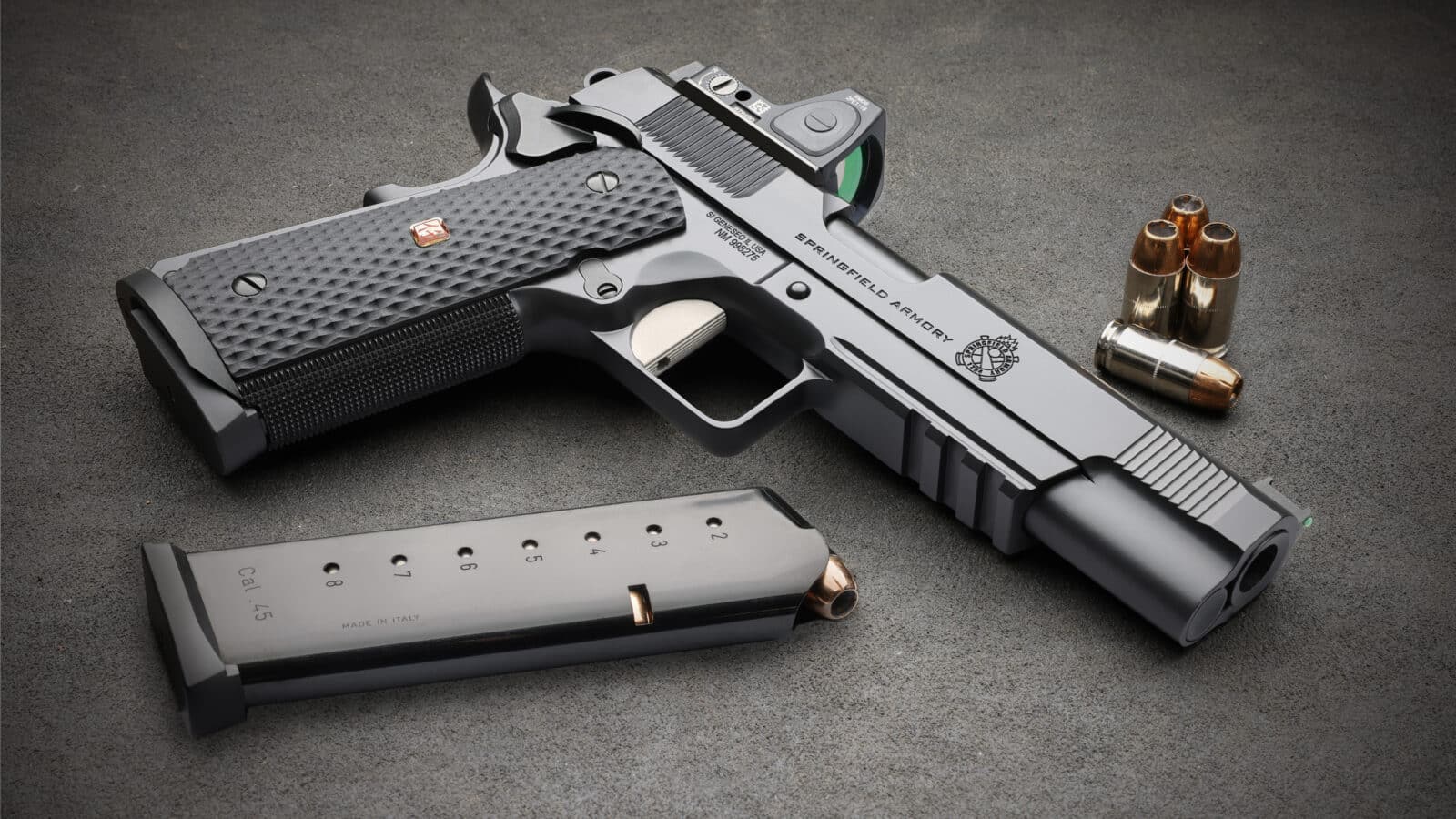
The 10-8 Performance Master Class is a 5” barreled, single-stack, full-size, railed 1911 — a true reflection of Yam’s experience and preferences. It is available in either .45 ACP or 9mm.

Live The Armory Life. The latest content straight to your inbox plus an automatic entry to each of our monthly gun giveaways!
In terms of 1911 reliability, a 5” full-size model — just as John Browning originally designed — is the gold standard. Today, companies like Springfield Armory are adept at building very reliable variations of the classic, from compact concealed carry models. But every change to the classic 1911 format carries its own set of considerations, so for a duty-ready 1911, I would have been shocked if Yam and Springfield chose anything other than a full-size model for this offering.
As for the rail, “If one wants to do much in the defensive, duty, or tactical realm, the option for mounting a weapon light is mandatory,” notes Yam. “Springfield was first to market with a railed 1911, just over 20 years ago, with the full-rail Tactical Response Pistol (TRP) Operator. I felt that a modern gun needed the capability for both a light and an optic.”
Although his original Bureau-issued Professional may have come sans rail, most of Hilton’s custom builds have been on railed “Operator” frames. When only performance counts, it makes sense to ensure your firearm accepts mission-critical and performance-enhancing accessories.

Speaking of accessories and Yam’s must-haves, the 10-8 Master Class is also optics-ready. Utilizing Springfield Armory’s AOS (Agency Optic System) mounting system, the pistol is ready to accept today’s popular micro-red-dot sighting systems.
“I have been shooting IPSC/USPSA on and off since the ’80s, and when Jerry Barnhart won the 1990 USPSA Nationals with a single-stack 1911 with an optic on it, he changed pistolcraft forever. I was one of the first in my USPSA club to have an optic-equipped race gun, and around 2012, I was one of the early beta testers for the Trijicon RMR. It is great to have seen the evolution and widespread adoption of the pistol-mounted optic from the very beginning.”
As an interesting aside, I had the opportunity to train with Hilton in 2022 when he came to Virginia for a weekend of classes. And, no, it wasn’t a 1911 armorer’s course or anything to do with SWAT-style shooting tactics. The class was simply called “Pistol Optics,” and it was an excellent course geared to improving the students’ performance with slide-mounted optics, whether they were entirely new to the concept or seasoned shooters refining their techniques.

There was an excellent block of instruction on target transitions that I still reference today when my target-to-target splits start to lag. To anyone looking for additional red-dot instruction, I’d heartily recommend perusing Yam’s catalog of internet content or keeping an eye out for training opportunities.
In addition to the AOS optic plates — which include mid-height rear sights for a lower 1/3 co-witness, depending on the optic — the dovetailed front sight features a green fiber-optic pipe. This is a great choice because the fiber optic will gather ambient light for easy acquisition in most indoor and outdoor environments. Too, the green will contrast with red-dot reticles, minimizing confusion in the sight picture.
Continuing from the top, the slide is a traditional round-top design. For slide serrations, the Master Class has cuts fore and aft that are relatively narrow and vertical, reminiscent of traditional 1911s, but with about 1/8 inch of smooth slide beneath them on the rear cuts.

Yam explained, “We wanted this pistol to feel fresh and modern, yet evoke notes of classic styling. [Also,] I have always designed with a certain functional aesthetic.” He continued, “The abbreviated slide serrations at the rear mitigate the sawtooth effect of the bottom of the slide on the shooter’s thumb when properly riding the thumb safety.” Practical, and visually appealing.
Barreling Forward
Probably the biggest departure from the 1911’s classic construction is the barrel and recoil assembly selected for the 10-8 Performance Master Class. Rather than a traditional barrel, barrel bushing, spring, and spring plug, Hilton opted for a cone barrel and a 10-8 reverse spring plug. “The cone barrel has been a feature that I long wanted to incorporate into my builds,” said Yam, “and I had always liked the cone-barrel TRP Operator models. The heavy cone barrel reduces recoil as well as simplifying assembly by eliminating the barrel bushing and incorporating my reverse spring plug with a G.I. length guide rod.”

I love this choice. There are definite benefits to the heavy-contour coned barrel, and there are real cost savings associated with eliminating the bushing — one less part to machine and, in performance 1911’s, hand fit. However, it’s the use of the reverse plug that really makes this assembly sing. Most cone- or bull-barreled 1911s use some form of full-length guide rod, and those require a tool (often a wrench or a pin) for disassembly. The systems are proven and work well. But, if, like me, you prefer your hard-use firearms allow for tool-less disassembly and lend themselves to “battlefield” maintenance, the reverse plug with the traditional GI guide rod is your answer.
Disassembly could not be easier. Simply withdraw the slide, aligning the half-round relief notch to remove the slide-stop pin. Then, simply ease the slide assembly forward, off of the frame, being sure to secure the recoil spring and guide rod as you do. The spring, guide rod and plug will easily come free, and the barrel can then be removed. Job done.
Fitting It Out
Many parts incorporated into the 10-8 Performance Master Class pistol, including the slide stop and reverse plug, are Yam’s own design. And, working down the gun, the blending of modern performance and classic aesthetic remains evident. “The square trigger guard was a nod to the classic guns that I grew up with in the ’80s, from [custom gunsmiths like] Pachmayr, Swenson, Hoag and many others. The 10-8 Performance small parts are my addition to that legacy: the trigger, slide stop, magazine catch, scoop grips. They’re all designed to improve efficiency and the shooter experience.”

Taking a closer look at those parts, it’s clear Yam intended to make his signature 1911 as easy to run as possible. The combination of flat trigger, scooped grips, and extended magazine catch are especially thoughtful and functional. All three of those components will be contacted by the same shooting hand, and all three make the gun more accessible to shooters regardless of hand size.
The flat, serrated trigger is easy to positively manipulate, even with shorter fingers. The deep scoop in the left-side stock panel shortens the distance the thumb must move to engage the magazine stop, which itself is extended to meet the thumb, and serrated for better purchase. Add to these features the G10 stocks’ raised-diamond texturing, the Springfield memory bump and extended beavertail grip safety, the 20 lines-per-inch (LPI) checkering on the frontstrap, the ambidextrous thumb safety, and the extended and flared two-piece magazine well.
It is abundantly clear that the 10-8 Performance Master Class is designed for sure grip and easy operation. Even its all-black finish, barrel, slide, and frame, just screams duty ready.
An Industry on Notice
The “Master Class” name is fitting for this project not only because of the expertise of its designer, but also because school is most definitely in session for a market currently awash in single- and double-stack 1911 pistols. When Springfield Armory reinvigorated its TRP line in 2024, it once again solidified its position as the pound-for-pound (dollar-for-dollar) leader in 1911’s.

The Master Class expands on Springfield’s foundation of quality with its 1911 pistols and offers signature features previously only available as aftermarket parts. Matched serial number engravings on the slide, frame, and barrel prove the Master Class guns are ones being built right by those who know how to do it.
And, priced at just $2,099 — thousands less than the cost of many custom builds — the pistols should fulfill Yam’s goal to make 10-8 Performance more accessible for 1911 enthusiasts. Thankfully, Springfield Armory and Lipsey’s were able to help him bring this amazing pistol to fruition.
Editor’s Note: Please be sure to check out The Armory Life Forum, where you can comment about our daily articles, as well as just talk guns and gear. Click the “Go To Forum Thread” link below to jump in!
Join the Discussion
Featured in this article

Read the full article here