
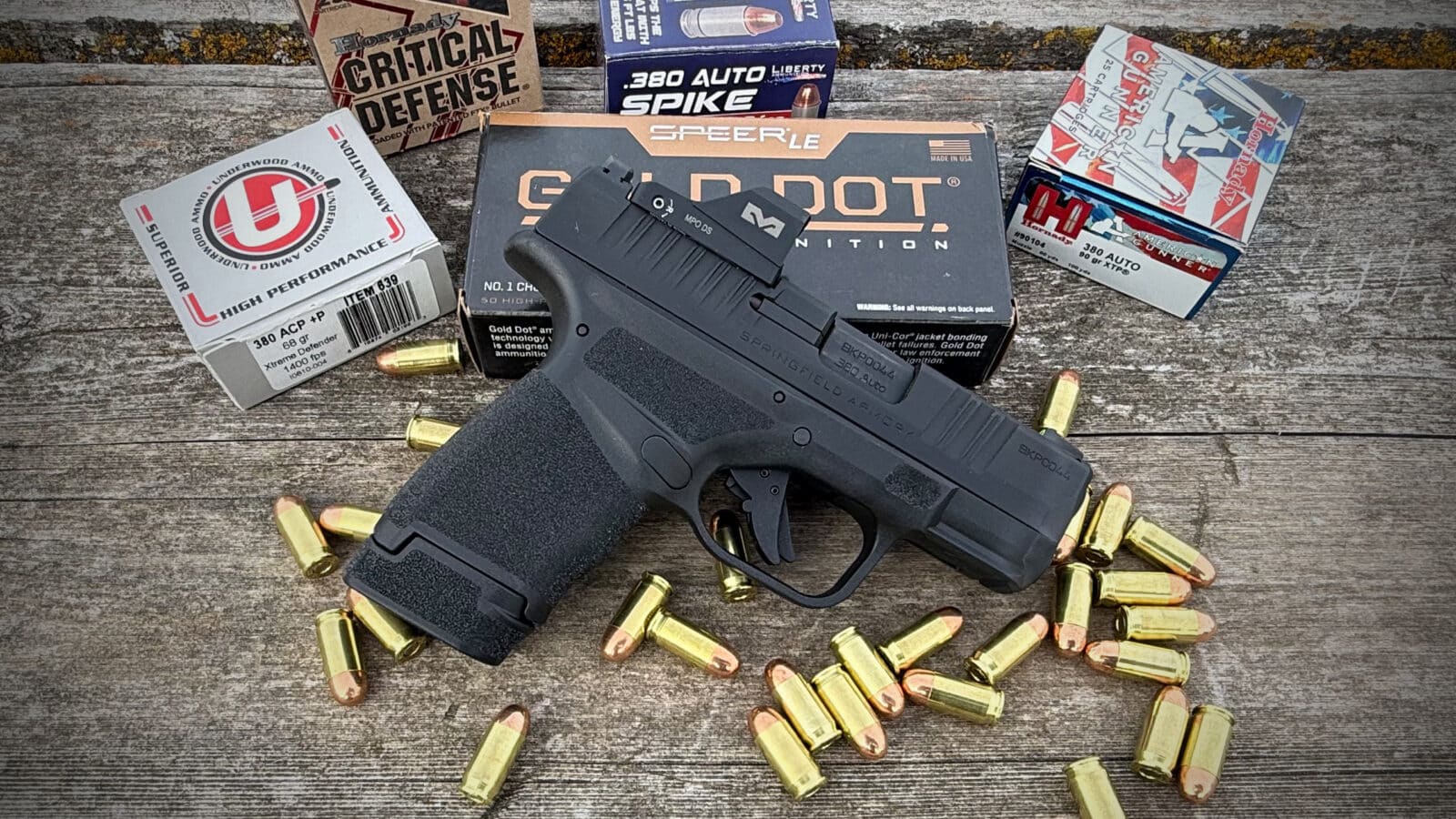
A topic that consistently attracts significant interest is self-defense, and the two most common subtopics are home defense and concealed carry. Based on my personal experience and conversations with folks, concealed carry seems to be of the most interest. Why? You don’t go out in public with your home defense gun, so it can be as large as a shotgun or carbine. You can’t really hide that on your person when going out to dinner.
When we get into conversations on concealed carry, the #1 point of interest seems to be the caliber of what folks want or need to carry for self-defense. This is a reasonable and logical place to start, and everything else follows that regarding size, weight, recoil, etc. The purpose of this article is not to debate what the best caliber is to carry for self-defense. Rather, if a person does or is interested in carrying a firearm chambered for the .380 ACP cartridge, what are the best options for self-defense ammo?
[Don’t miss our Springfield Hellcat .380 review for additional information about this amazing CCW pistol.]
A Little Background
Before we review my top six choices for .380 ACP ammo, I want to briefly discuss why many folks are interested in the .380 for concealed carry.

First, I think we need to point out that the purpose of “self-defense” is very different than that of law enforcement and the military. Police officers and the military don’t need to conceal their guns most of the time, which makes a huge difference when choosing what caliber and gun to carry.
[Be sure to catch Fred Mastison’s take on the best self-defense caliber.]
Secondly, I want to address why more people are interested in carrying the .380 ACP these days. I know a lot of folks who believe the 9mm is the minimum to carry. It is a good choice for this, and possibly the best, and it’s what I have often carried. So why consider the .380 cartridge? Recoil.

This is a significant issue for more people than one might think. Specifically, I know a lot of older folks who carry or want to carry but just don’t have the hand strength anymore to handle the recoil or rack the slide of a small 9mm. The same can hold true for women. You have to be comfortable shooting what you are going to carry, or you won’t carry it.
[Catch David Higginbotham’s opinion on How Much Ammo Should I Carry?]
In my opinion, the .380 addresses this issue for many and still has enough punch for personal protection. Pistols like the Hellcat .380 ACP offer the same impressive capacity (up to 13 rounds) as the 9mm, but with less weight and recoil, typically in a lighter, smaller gun. You can rack it with less strength, and, as I will show you, it is ballistically effective for defensive use.

Live The Armory Life. The latest content straight to your inbox plus an automatic entry to each of our monthly gun giveaways!
I reviewed Springfield’s Hellcat 9mm when it came out, and I love it and carry it. As a point of reference, since many consider the 9mm a “minimum” for self-defense and concealed carry, I wanted to share that a typical speed in fps from a 9mm this size is around 1,020, with average foot-pounds of energy (ft/lbs) around 320. The other thing that is important for folks is depth of penetration, and this is typically between 12-15” in a 9mm this size using hollow-point ammo. I think this is helpful when considering the .380 ACP, especially its ammo.
The Types
Here are the six different types of ammo I selected for this comparison:
- Hornady American Gunner 90-gr. XTP HP
- Hornady Critical Defense FTX 90-gr. HP
- Speer Gold Dot 90-gr. GDHP
- Liberty Ammo Civil Defense 50-gr. HP
- Liberty Ammo SPIKE 55-gr. HP
- Underwood 68-gr. +P Xtreme Defender
I chose the three traditional hollow-point loads based on what I have and also what I hear is most commonly carried. I chose three very non-traditional rounds to maximize speed and energy and see whether that addresses concerns about the 380’s effectiveness.

Let’s examine all six of them for the following:
- Specifications
- Ballistics using the Hellcat
- Accuracy
- Benched at 25 yards
- Standing at 10 & 15 yards
- Ammo weight of 13 rounds (max in Hellcat)
- Ballistic gel test
Specifications
The first three are very traditional hollow-point rounds, all 90 gr. Only the Speer was a bonded bullet, meaning the lead core is bonded to the copper jacket, so you will not get jacket separation and achieve maximum expansion diameter. That said, neither of the Hornady loads showed jacket separation in the gel test.

Both Liberty Ammo (Civil Defense & SPIKE) are all-copper hollow points designed to fragment quickly in the target, with the base penetrating deeper. At 50 and 55 grains, the speed is significantly faster, and ballistics in gel are very different from traditional hollow-point loads. The idea behind these rounds is to increase speed, resulting in higher energy and fragmentation that create multiple wound channels while still maintaining penetration at the base. The all-copper bullets are lighter and weigh almost half as much as the traditional HPs and produce noticeably less recoil — something that could be a benefit for choosing a .380.

The Underwood is also an all-copper bullet with a unique fluted design that does not expand or mushroom, achieving maximum penetration while producing extreme cavitation compared to traditional hollow-point bullets. Because it is all-copper and will not expand/mushroom, you have much better performance through barriers. The lighter-weight bullets also produce less recoil, but that effect may be offset by the +P power rating.
Ballistics
The difference between the first three traditional hollow-point loads and the last three non-traditional rounds was significant in terms of speed and energy.
The three traditional hollow-points perform very similarly and as expected:
- Hornady American Gunner — 887 avg fps speed, 170 max ft/lbs energy
- Hornady Critical Defense — 930 avg fps speed, 175 max ft/lbs energy
- Speer GD — 983 avg fps speed, 204 max ft/lbs energy
The Liberty ammo had both greater speed and energy:
- Civil Defense — 1,511 avg fps speed, 260 max ft/lbs energy (FASTEST)
- SPIKE — 1,469 avg fps speed, 269 max ft/lbs energy
The Underwood was not the fastest of the six, but it did produce the greatest energy:
- 1,331 avg fps speed, 281 max ft/lbs energy (MOST ENERGY)
Accuracy
I tested them standing at 10 & 15 yards, shooting approximately one shot per second (or 10 rounds in 10 seconds) at a 4×5.5” oval. I did this to simulate an actual shooting situation where you want to get rounds off as quickly as possible while still hitting the target accurately. Then, to show the maximum accuracy of each round, I bench-rested them at 25 yards and took my time to place the most accurate shots I could.

The three traditional hollow-points perform very similarly, with nice groups, I think most would be happy with. With all three, I kept all 10 shots in the bullseye at 10 yards and at 15 yards, though the groups expanded by a couple of inches with a few fliers.
I have to be completely honest: I expected the Liberty ammo to produce larger groups with less consistency, given the bullet design. I was very pleasantly surprised, though, with the Civil Defense being the tightest group at 10 yards over them all, with an approximately 2” consistent group. It was one of the best, if not the best, at 15 yards. The SPIKE shot a little low and left for me, but would all easily be in the bullseye at 10.

The Underwood performed well at both 10 and 15 yards. See the video to see all the groups and the speed at which they were shot.
At 25 yards benched, I was really impressed with the gun, ammo, and red dot. Groups were VERY impressive. Those circles in the photos are 4” diameter circles. While they all grouped well, the SPIKE was hands down the best with a total 2” group (if you get rid of the one flyer, it would be a 1” group).
Ammo Weight
I weighed 13 rounds of each to show the difference. It’s not a huge difference overall, but it does make a difference.
- Hornady American Gunner 90 gr XTP HP: 4.0 oz.
- Hornady Critical Defense FTX 90 gr HP: 4.3 oz.
- Speer Gold Dot 90 gr GDHP: 4.2 oz.
- Liberty Ammo Civil Defense 50 gr HP: 3.0 oz.
- Liberty Ammo SPIKE 55 gr HP: 2.2 oz.
- Underwood 68 gr +P Xtreme Defender: 3.4 oz.
Ballistic Gel Test
You really must see the accompanying video to fully grasp what each of these rounds does in gel. Below, I will give you the depth of penetration of each, but it is hard to put into words what you see with the cavitation or PWC.

I will say the Underwood was the most impressive for depth of penetration and cavitation, but the SPIKE was also very impressive. The Liberty ammo “fragments,” sending pieces of copper in all directions in a forward cone covering about 3” in diameter to a depth of 5” with impressive penetration of the core/base up to 13”.
- Hornady American Gunner: 12.5″
- Hornady Critical Defense: 10.5″
- Speer Gold Dot: 9.5″
- Liberty Ammo Civil Defense: 12″ (core/base) multiple fragments star burst
- Liberty Ammo SPIKE: 13″ (spike) multiple fragments star burst
- Underwood: 15.5″
Bottom Line
So there you have it — all the data on the six loads I tested. Take a look at it, weigh it all, and make your decision. With a high-quality pistol like the Hellcat chambered for the .380 ACP cartridge and a selection of capable defensive ammo, you have some great options!
Editor’s Note: Please be sure to check out The Armory Life Forum, where you can comment about our daily articles, as well as just talk guns and gear. Click the “Go To Forum Thread” link below to jump in!
Join the Discussion
Featured in this video






Read the full article here