
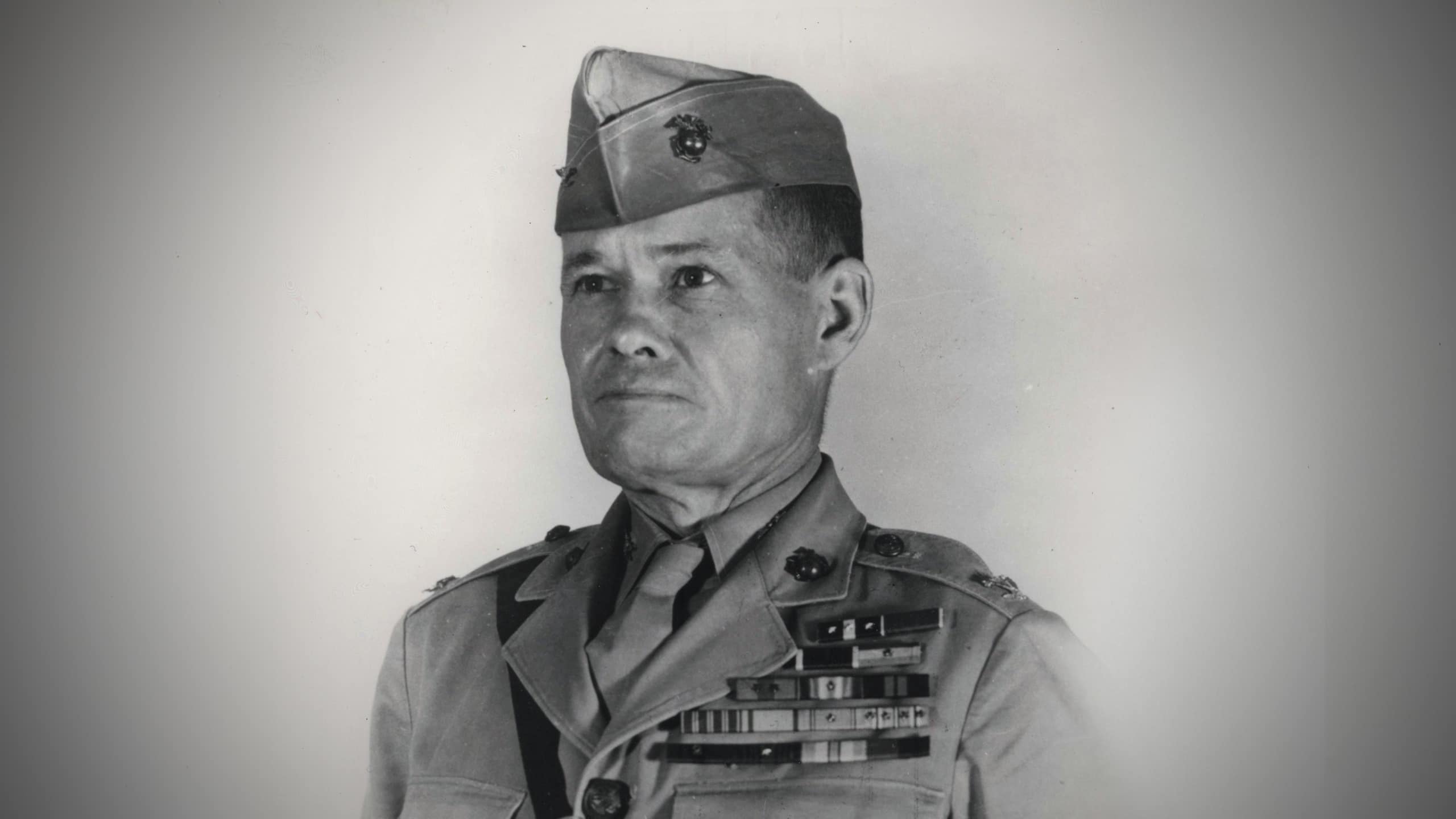
Lieutenant General Lewis Burwell “Chesty” Puller is the most decorated Marine in U.S. history and has been awarded the nation’s second-highest military award for valor six times, with five Navy Crosses and one Distinguished Service Cross.
He fought guerrillas in the Haitian and Nicaraguan “Banana Wars,” then led his men to hard-won victories at Guadalcanal, the landing at Inchon, and the frozen hell of the Chosin Reservoir in Korea, becoming a Marine Corps icon along the way.
Early Life
Born in 1898 in West Point, Virginia, he was of English ancestry with ancestors who emigrated to the Virginia Colony in 1621. As a boy, he listened to Civil War veterans recount their experiences and was fascinated by General “Stonewall” Jackson. Puller was destined for military service, and he attempted to enlist in the U.S. Army to fight Mexico in the border war (learn about America’s hunt for Pancho Villa), but could not get his parents to consent.

He then enrolled at Virginia Military Institute, but dropped out in August 1918 to join the Marine Corps. Chesty completed basic training at the Parris Island Recruit Depot but was unable to serve in World War I. He was sent to NCO and Officer Schools and commissioned as a second lieutenant in the Marine Corps Reserve, but a post-war reduction-in-force put him in inactive status with a reduced rank of corporal.
Haiti & Nicaragua
In 1915, after the assassination of Haitian President Vilbrun Guillaume Sam, the U.S. invaded Haiti to secure American interests and fight the Caco rebels, who operated in the country’s mountainous regions. In 1919, Puller was stationed there and fought in over 40 engagements with the insurgents. In June 1924, Puller was sent stateside and finally regained his commission as a 2nd Lt.

In December 1928, Puller was sent to Nicaragua and commanded a detachment of the Guardia Nacional. While in country, Puller honed his skills in guerrilla warfare and earned a Navy Cross for “five successive engagements against superior numbers of armed bandit forces.”

Puller returned to Fort Benning for an officer’s course and then returned to Nicaragua, earning a second Navy Cross for leading Nicaraguan National Guardsmen and U.S. Marines in the last battle against Sandinista forces.
China & The USS Augusta Under Nimitz
After leaving Nicaragua, Puller was assigned to the Marine Security detachment at the American Legation in Beijing. After leaving China, he was transferred to the cruiser USS Augusta (CA-31) under the command of Captain Chester Nimitz.

In June 1936, Puller was stationed as an instructor at the basic school in Philadelphia, the Corps officer training school. A year later, he was sent back to the Augusta, now as the Commander of the Marine Detachment. In August 1941, Puller was given command of the 1st Battalion, 7th Marines of the 1st Marine Division at New River (Camp LeJeune).
World War II
The fight was on in the Pacific theatre, and in May 1942, the division was sent to defend Samoa. In mid-September, they were deployed to Guadalcanal. Upon arriving, the division was surrounded by Japanese forces along the Matanikau River. Puller went ashore and signaled the destroyer USS Monsen (DD-436) to provide supporting fire while Marines evacuated by landing craft.

During the battle, U.S. Coast Guard signalman Douglas Munro provided covering fire for the Marines from his landing craft and was killed. Munro would be awarded the Medal of Honor posthumously for his actions, making him the only Coast Guardsman ever to receive the award.
Battle for Henderson Field
In October 1942, Puller commanded the 1st battalion, 7th Marines, who, along with the U.S. Army 164th Infantry Regiment, engaged a regiment-strength Japanese Infantry unit to defend the airfield. When the battle was over, the two units suffered 70 killed, while the Japanese sustained over 1,400 dead. Puller nominated two men for the Medal of Honor for their extraordinary heroism, including famed Sgt. John Basilone.
The Battle of Peleliu
Between September and October 1944, Puller, with the 1st Marine Regiment, engaged the Japanese during the Battle of Peleliu, one of the bloodiest battles in Marine Corps history. Puller received his first Legion of Merit, but came under scrutiny due to his refusal to request U.S. Army infantry reinforcements in reserve against the well-entrenched Japanese forces. Gen. Robert Geiger, the Marine Corps Commandant, ordered the exhausted 1st Division out because they were no longer combat-effective.

Puller was sent stateside as the executive officer of Infantry Training at Camp Lejeune and, at the war’s end, was made the commanding officer of the Marine Barracks at Pearl Harbor.
Korea
At the start of the Korean War, Puller returned to his roots with the 1st Marine Regiment. He landed at Inchon, earning a silver star, and earned his 5th Navy Cross for actions at the Battle of Chosin Reservoir, where he uttered one of his many famous quotes, “We’ve been looking for the enemy for some time now. We’ve finally found him. We’re surrounded. That simplifies things.”

Puller and his men repelled waves of enemy attacks by larger forces. During the fight, Puller moved along the defensive line, dodging machine gun, artillery, and mortar fire while directing his troops, keeping supply routes open for the division.
Live The Armory Life. The latest content straight to your inbox plus an automatic entry to each of our monthly gun giveaways!
Puller was promoted to brigadier general in January 1951 and made assistant division commander. In May 1951, he returned stateside and took command of the 3rd Marine Division at Camp Pendleton.

In July 1954, Puller took command of the 2nd Marine Division at Camp Lejeune. he was soon promoted to deputy Camp Commander. Chesty suffered from high blood pressure and had heart issues. After conducting a unit inspection, Chesty suffered a stroke. Chesty attempted to remain in the Corps, but a medical board saw otherwise, and he was medically retired and promoted to lieutenant general.

Why “Chesty”
Chesty earned the nickname for his prominent barrel chest, and “Chesty” in Corps slang means cocky. But as with all things Chesty, there were tall tales and myths. Marines under his command said he got the nickname from his ability to yell out orders over the noise of battle, stating, “We don’t need frontline communications; Chesty yells commands up and down the line, you can hear him for miles.”

Perhaps the best myth is that during battle, Chesty suffered a major wound to his chest, which was replaced with a steel plate!
His Legacy
Chesty Puller is a Marine Corps icon, whose honors include two ships named after him. There is also the Distinguished Marines stamps issued by the United States Postal Service, which honor Puller along with John Basilone, Daniel J. Daly and John A. Lejeune. The Marine Corps mascot is perpetually named “Chesty Pullerton,” and in honor of Chesty’s family roots, he is always a purebred English Bulldog.

Recruits in Marine Corps boot camp end their day by saying, “Good night, Chesty Puller, wherever you are!” Other everyday sayings include “Chesty Puller never quit!” In boot camp cadences, Marines yell, “It was good for Chesty Puller, and it’s good enough for me.” During pull-ups, Marines encourage each other to “do one more for Chesty!” Each year, the Marine Corps Detachment from Fort Lee, Virginia, runs 66 miles to Puller’s grave at Christ Church Cemetery in Saluda, Virginia.

Chesty passed away in 1971, and throughout his 37-year career, he exemplified service and leadership and symbolized the Marine Corps esprit de corps.
Editor’s Note: Please be sure to check out The Armory Life Forum, where you can comment about our daily articles, as well as just talk guns and gear. Click the “Go To Forum Thread” link below to jump in!
Join the Discussion
Read the full article here