
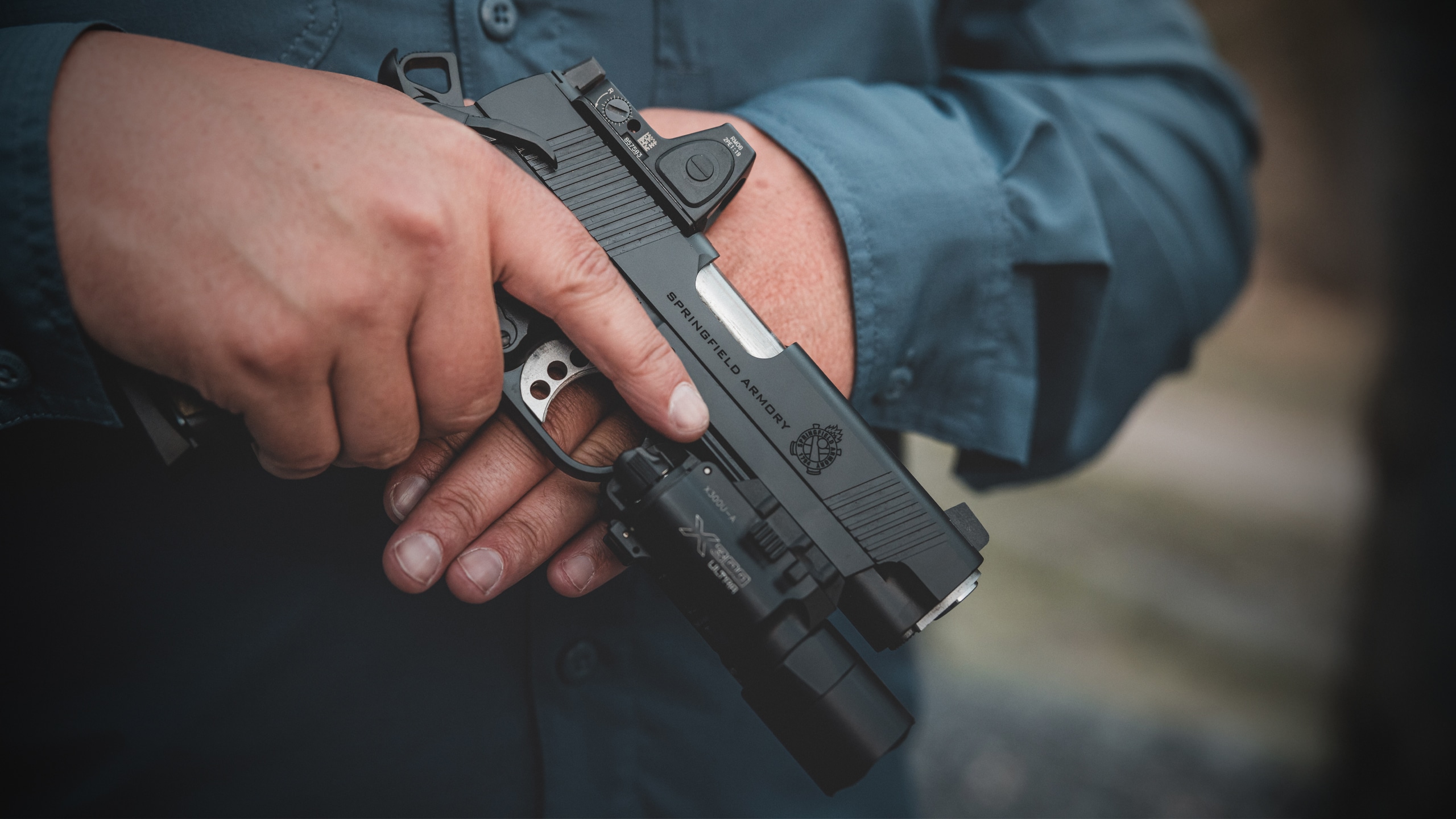
There’s a clarity of purpose when it comes to single-action pistols like the 1911. The single-action was the first type of semi-automatic pistol, and it still remains popular through to today. Sir Winston Churchill claimed such a gun, the Mauser C96, saved his life in the Battle of Omdurman in 1898.
On our side of the Atlantic, the 1911 .45 was killing America’s enemies before World War I, and did so through that conflict, as well as World War II, Vietnam, and even into the 21st century’s War on Terror. The Texas Rangers availed themselves of the 1911 as soon as it was adopted in the eponymous year, and it remains a signature gun of that fabled group of lawmen to this day.
Indeed, in an era of striker-fired service pistols, the 1911 is undergoing a resurgence of popularity through variants like the increased-capacity Springfield Armory Prodigy 9mm series.
Of course, 1911’s have been protecting American homes and law-abiding concealed carriers the whole time through today. Additionally, pistols of the 1911 breed continue to rule in high-level handgun competition, from the Precision Pistol discipline to NRA Action Pistol and more.
So, let’s look at why it’s still with us in a time of different designs that might arguably be simpler to operate, lighter to carry, or hold more cartridges. In every criterion for selection, as with any firearm — or any tool or machine, for that matter — there will be strengths we will want to go toward, and weaknesses we will want to shore up.
Proprietary Nature
It is almost unanimously understood that for combat or self-defense purposes, a pistol such as a 1911 or an SA-35 should be carried “Condition One.” This where you have the pistol “cocked and locked” with a live round in the chamber. The hammer is back and the thumb safety is engaged and in the “on-safe” position.

If an unauthorized person were to gain control of the firearm, a cocked and locked gun requires the safety to be thumbed down into the “fire” position to shoot. Studies have shown that someone unfamiliar with this design may take around 18 seconds to figure out where the little lever is that “turns it on.”
In 1977, a decade after the Illinois State Police (ISP) became the first major law enforcement agency in the U.S. to adopt a semi-automatic to replace the traditional service revolver, I undertook a study with the ISP that found 13 troopers were alive because they had this nine-shot semi-automatic pistol. This pistol featured a decocking lever that doubled as a manual safety. It was left up to the individual troopers whether they carried it on-safe or off-safe.
[Be sure to read 1911 Carry Conditions Explained for additional information.]
The study revealed four troopers were alive because they had the extra few shots or the faster reloading speed over their previous revolvers. However, the other nine had their pistol wrestled away from them, but survived the attack due to the fact their pistols had the safety engaged. This gave them time regain control of their firearm.

Now, the downside: the legitimate user of the pistol has to remember to thumb the safety off when they are being attacked. This comes down to training. I have not yet found a case of a Good Guy or Gal getting killed because they forgot to take their safety off when they had to fire to defend their lives.
One does not thumb a 1911’s safety lever down into the “fire” position until they believe they are about to have to fire. In a “ready” position, the thumb is poised on the safety lever to do exactly that, and the finger is still outside the trigger guard until the decision to intentionally fire is made.
Some four decades ago, police gun expert Winston Dill — who carried a 1911 — was the first to show me a ready position with the thumb under the locked safety, ready to reach up and flip it down so the gun wouldn’t be “off-safed” by a startle response. Most users keep the safety “on” with their thumb right on it ready to wipe it down to “off” and fire.

Either way is acceptable … but they each need to be intensively practiced. So does thumbing the safety back up to the “on” position when the shooting is done, and certainly before the gun is holstered.
Holstering the 1911
If we holster with the gun in the firing grasp, we have depressed the grip safety. You MUST remember to engage the thumb safety before you start this process. Otherwise, if something were to get into the trigger guard — a fold of clothing, etc. — you could be encountering an unnecessary risk.

We don’t want to palm the gun as we holster (see photos), but I believe it’s helpful to put the thumb on the cocked hammer. If it starts to go forward, the thumb blocks it and prevents the shot. The web of the hand in this position also comes off the grip safety, putting it “on” and creating another layer of safety.
Why Cocked and Locked?
What about those that think carrying a gun around with the hammer cocked is “dangerous”? Are there alternatives? There is having the hammer down on an empty chamber but holding a full magazine, commonly known as Condition Three. However, in my opinion, this has no advantage whatsoever with a properly set up single-action auto like the Springfield Armory 1911 series, which is designed to be resistant to firing if dropped.

In real-world encounters, the defender often has only one hand to manipulate the pistol; the other hand may be pushing an assailant away or working an illumination or communication device. Without that hand to work the slide, it is slow and difficult to rack a round into the chamber, particularly in a dynamic situation. You’re basically carrying a reactive self-defense weapon with which you cannot immediately react. No bueno. The only reason to carry that way would be if your 1911 was not drop-safe, which was the case with the old G.I. issue guns.
What about hammer down on a live round, a/k/a Condition Two? One-handed thumb-cocking of a 1911, because its hammer is so much farther back than on a revolver, is extremely awkward, fumble-prone and slow. It’s also unsafe in my opinion, since getting it to that condition requires you to pull the trigger of a loaded pistol you don’t want to shoot.

Thus, the almost universal recommendation of experts to carry this type of pistol cocked and locked with a torpedo in the launch tube — Condition One.
If the cocked hammer bothers you or those around you, one option is a thumb-break holster which intersperses a safety strap between hammer and firing pin. And if you carry it concealed, whom will it alarm?
Will the Safety Slow You Down?
Not if you practice with it. With a draw to an intended shot, the thumb wipes off the safety at the same moment the gun comes up into the target and the finger enters the trigger guard. By 1960, Jeff Cooper and his contemporaries such as Ray Chapman, Leonard Knight, and others had won quick draw contests against revolvers and double-action autos with their cocked and locked 1911 .45s. Of course, those men practiced…and so must any serious user of the single action semiautomatic pistol.
Holding the Single Action Auto
If the 1911’s grip safety bothers you, there’s always the SA-35 9mm that doesn’t have one. There is a school of thought that the thumb should ride the thumb safety when shooting so the pistol doesn’t “on-safe” itself.

Live The Armory Life. The latest content straight to your inbox plus an automatic entry to each of our monthly gun giveaways!
Personally, I’m not from this school. The problem with riding the safety is that (1) a big or gloved thumb can apply friction to the slide, interfering with cycling, and (2) that grasp pulls the web of the hand away from the grip safety, potentially causing the gun to fail to fire. Simply curling the thumb down cures that problem and also gives you a stronger grasp.
Downside?

Nothing is perfect. The 1911 is more complicated to detail strip and reassemble than the typical striker-fired pistol. It also demands more attention to lubrication. Treat it like your automobile: keep it oiled and it’s not likely to seize up on you. Any of us who’ve been with 1911’s a long time will tell you that we clean them more frequently than we do our striker guns. It’s simply the nature of the beast.
Conclusion
Does a 1911 need modern features such as a light rail or optic sight capability, or a double-stack magazine holding lots of 9mm rounds? Don’t worry, a quick run through the Springfield Armory catalog will show you 1911’s in all those configurations. If you want a classic one, they have a classic one. If you want a more modern one, they’ve got that (and just about everything in between) as well.

Every tool has pros and cons, and idiosyncrasies the user must be in tune with. Generations of shooters have gotten in tune with the 1911. I’ve found that the advice above has let me maximize the 1911’s advantages and minimize its relative disadvantages.
Editor’s Note: Please be sure to check out The Armory Life Forum, where you can comment about our daily articles, as well as just talk guns and gear. Click the “Go To Forum Thread” link below to jump in and discuss this article and much more!
Join the Discussion
Featured in this article


Read the full article here