
The state of the art in modern special operations, frankly, is remarkable. In 2011, a group of elite Navy SEALs inserted via stealth helicopters deep inside hostile territory to kill the most wanted terrorist on Planet Earth. They successfully accomplished this daring mission for the loss of a single aircraft. Friendly forces exfilled unharmed, and the world stood amazed. However, that didn’t just happen.
Operation Neptune Spear, the mission to kill Osama bin Laden, was the end result of decades of tactical evolution. The Son Tay Raid in Vietnam, the Israeli raid on Entebbe, and Operation Nimrod, wherein the British SAS took down Prince’s Gate in London — each of these bold missions was more audacious than the last. But where did all that start?
Origins
Modern special operations really had their genesis in World War II. The British 22nd Special Air Service and the American OSS led the charge. For the Axis, however, special operations really orbited around a single man. That pioneering German commando was SS Obersturmbannführer Otto Johann Anton Skorzeny.

Otto Skorzeny was a physically imposing guy. At a time when the average corn-fed American draftee stood five foot eight, Skorzeny was six foot four. He also sported a prominent dueling scar across his left cheek. In 1939, Skorzeny tried to fly combat aircraft for the Luftwaffe but was considered both too big and, at age 31, too old. Instead, he entered the Waffen SS and embarked on a career as a shadow warrior.
Accomplishments
We will have to briefly suspend our justifiable revulsion at the SS and its dark association with genocide to fully appreciate Skorzeny’s contribution to modern spec-ops. Skorzeny fought for what was arguably the most depraved regime of the modern era. However, that does not diminish the man’s martial prowess.

Skorzeny freed the Italian fascist dictator Benito Mussolini from the mountaintop fortress at Gran Sasso in 1943. He kidnapped the son of Miklos Horthy, the Hungarian head of state, from under the noses of his troops. Hitler then used the younger Horthy as leverage to keep Hungary in the war on the Axis side. Skorzeny also commanded the 150th SS Panzer Brigade, the English-speaking Germans who infiltrated behind American lines to sow chaos during the Battle of the Bulge. He was not captured and executed alongside his men because he was deemed both too large and too distinctive to pass himself off as an American soldier and be a part of that mission. Now, hold that thought…
The Gear
Modern special operators require specialized gear. Weapons employed by special forces are often smaller, lighter, stealthier, and more concealable than those used by their ground-pounding counterparts. A critical part of all that is crafting firearms that don’t make excessive noise.
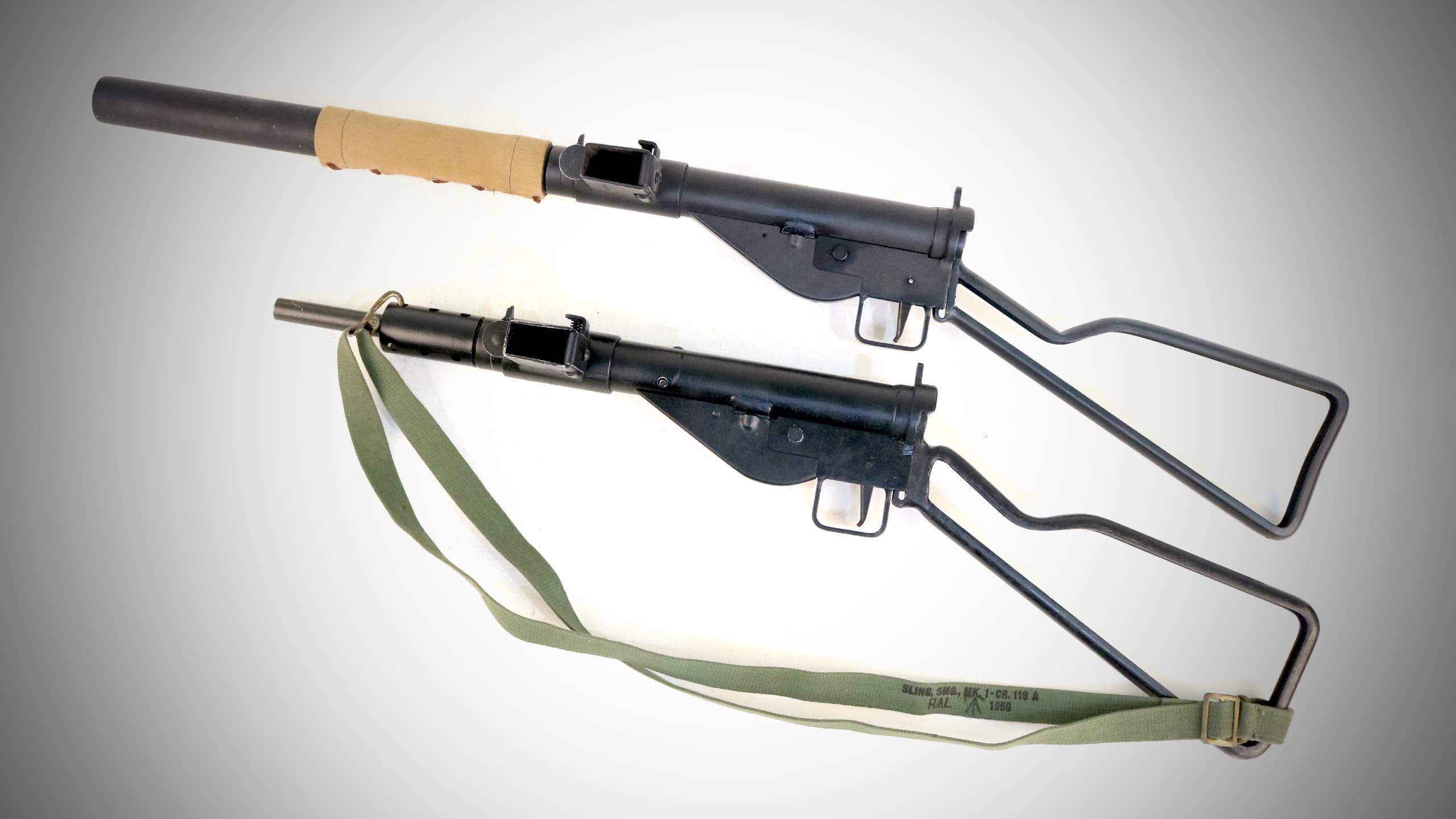
Nowadays, you can’t eat at the cool kids’ table at the local range if you don’t have a sound suppressor threaded onto the snout of your favorite gat. However, back in the 1940s, such tech was in its infancy. The state of the art back then was the British Mk IIS Sten.

Designed by Major Reginald Shepherd and Harold Turpin while working at the Royal Small Arms Factory at Enfield, the name “Sten” is a portmanteau combining letters from each man’s name as well as the Enfield factory. More than four million copies were produced in at least seven different marks. The cheapest version costs $9 apiece. That would be about $150 today. This inexpensive 9mm submachine gun of WWII helped save the British nation during those dark days.

Live The Armory Life. The latest content straight to your inbox plus an automatic entry to each of our monthly gun giveaways!
All Sten SMGs fed from the left via an execrable double-column, single-feed 32-round box magazine. The Mk II was the most common version. This variant featured a selective-fire action common to all Stens, as well as a rotating magazine well that could be rotated to seal the action against contaminants. The Sten Mk II readily broke down into four components for transport or concealment. While the Sten gun was a marvel of modern manufacturing efficiency, the sound-suppressed Mk IIS was legitimately revolutionary.
Mk IIS — The Silent Wonder
9×19 mm Parabellum ammunition is naturally supersonic. A sound-suppressed firearm firing supersonic ammunition is going to make a lot of noise no matter what wondrous things you might do to mitigate its intrinsic racket. The speed of sound in dry air is 1,125 feet per second. Standard 115-gr. 9mm from a Sten clocks in at around 1,200 fps. The Mk IIS employed a ported barrel that automatically dropped standard service ammunition into the subsonic range. This is not an uncommon solution to the supersonic problem today. It was groundbreaking back in 1943.

Nowadays, we use CNC mills and metal 3D printing to produce complex shapes that maximize the effectiveness of our sound suppressors. During WWII, the designers of the Mk IIS used a series of wire-mesh disks. Think window screen material. This worked shockingly well. However, the suppressor got hot very quickly and didn’t last terribly long. The Mk IIS came equipped with a canvas cover to help protect the shooter’s hand, and troops were trained to fire the weapon on semi-auto to maximize its efficiency and lifespan.
Back to Otto Skorzeny
Skorzeny coveted a sound-suppressed, pistol-caliber SMG for his special operators in the worst way. There was some tepid research on both 9mm P.08 Luger pistols and 9mm MP40 submachine guns, but nothing of consequence emerged. The few copies of the suppressed Mk IIS Sten that were captured by the Germans were redesignated the MP 751e. Skorzeny had an example for his personal use.

Otto Skorzeny tried to get Nazi logisticians to allocate precious resources to support his special operations troops. However, nobody would take him seriously when he requested a stealthy 9mm submachine gun. Firearms are noisy. There was clearly little to be done about that.

To prove his point, Skorzeny supposedly tucked his captured Mk IIS Sten gun underneath a long coat while out walking with a German official in downtown Berlin. On a crowded street, Hitler’s favorite commando then stepped behind his counterpart, produced the weapon, and emptied a magazine into the air without alarming either his companion or the other Berliners strolling about around them.
The SS officer made his point. However, by that phase of the conflict, submachine guns were not going to turn the tide. The Nazis were already doomed. Meanwhile, the Mk IIS Sten gun eventually led to the extraordinary sound-suppressed weapons in common use today.
Editor’s Note: Please be sure to check out The Armory Life Forum, where you can comment about our daily articles, as well as just talk guns and gear. Click the “Go To Forum Thread” link below to jump in!
Join the Discussion
Read the full article here