
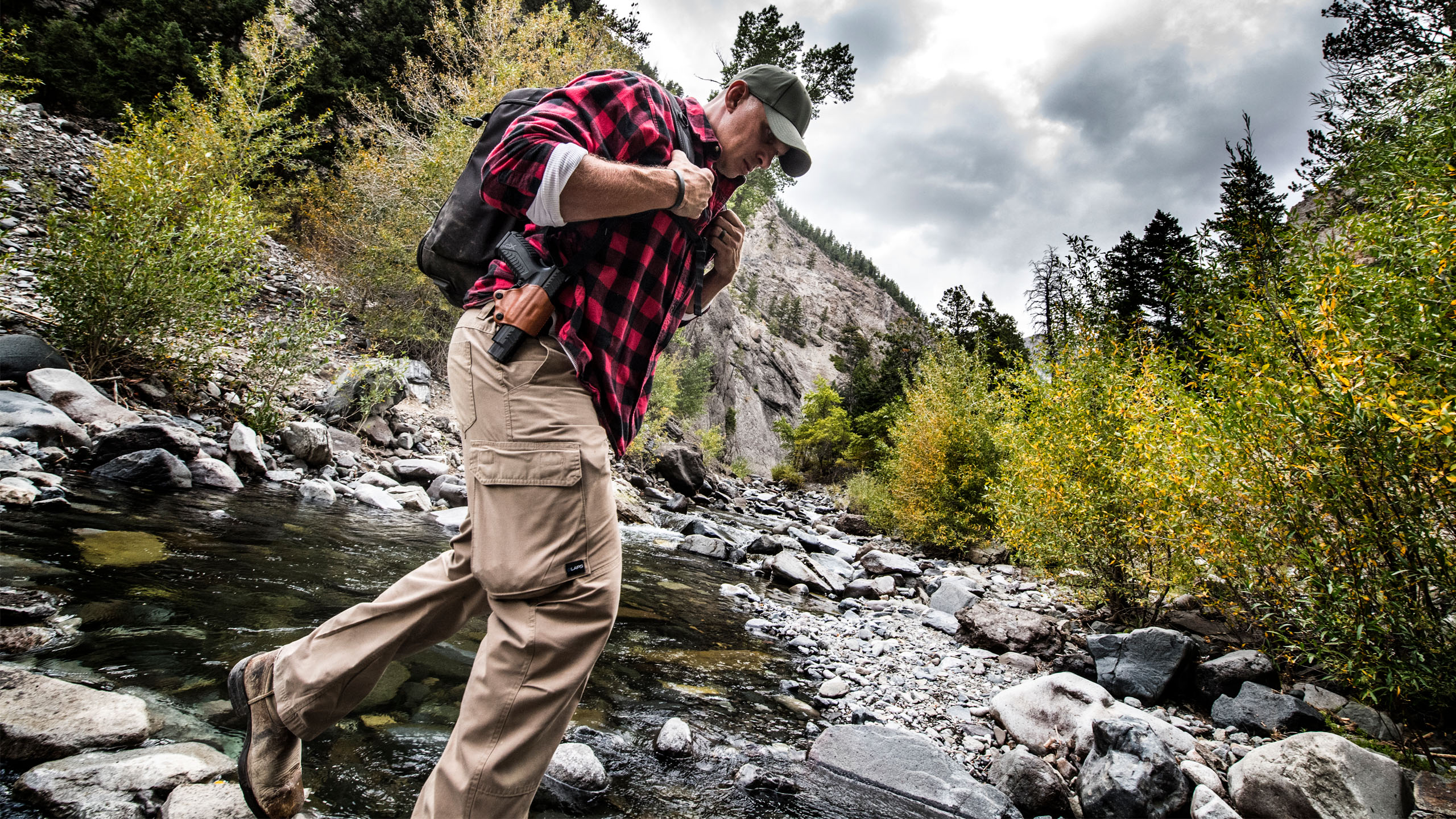
There’s something invigorating about heading into the backwoods with only the essentials on your person. Walking through the forest provides a sense of peace and tranquility that urban areas fail to deliver.
The environment, your equipment, and you are the only things that exist in those spaces, and entering them without proper planning can constitute dangerous behavior. Over the years, I’ve seen hikers head out with minimal supplies — such as a water bottle and a pocket knife — and come back with blisters and dehydration.
I’ll admit, I used to be like that in my earlier years before learning the right way to do these sorts of things. What’s the saying? An ounce of prevention …?
My Kit
The woods taught me through experience and challenging learning exercises to create a very specific backwoods carry system, where legally applicable. In my case, it’s built around a 10mm Springfield Armory XD-M Elite 4.5” OSP.

In addition to this capable 10mm pistol, my daily backcountry equipment is built around the concept of the gear I need to protect myself in the smallest, lightest, and most packable configuration possible.
I select all my equipment, including the water purification system and medical kit, because they operate reliably in demanding environmental conditions.
I have spent years developing my backpack contents through actual outdoor experiences, including hiking long distances and dealing with unpredictable weather and backcountry emergencies, which have proven each item worthy of its spot.
Why the 10?
I’ve always favored the 10mm for carrying in the backwoods. The XD-M Elite OSP 10mm provides exceptional capabilities and a range of operational features, making it suitable for protecting against unforeseen threats.

This 4.5” model is a size that is “just right” and is very practical for this purpose. Its size is large enough to manage recoil well, while remaining compact enough for comfortable carry in an outdoors-oriented loadout.
Out of the box, the XD-M Elite points naturally. The grip design fits my hand perfectly, while the optics-ready OSP-cut slide allows me to mount a red dot sight — vital when moving quickly through thick vegetation or operating in dark conditions. There’s a certain peace of mind in knowing that, no matter the terrain or situation, the firearm in my hand is instinctively aligned with my target.

Over time, I’ve learned that comfort and familiarity are just as important as power. I carried the XD-M 10mm daily on hikes and overnight trips, training with it until every aspect of its operation became second nature. The backwoods require a reliable handgun that I can handle naturally, and this platform provides that exact functionality.
Ammo Selection
A backwoods carry gun is only as good as the rounds you feed it. I use hard-cast loads for wildlife threats, and hollow points for more traditional self-defense scenarios.

The Buffalo Bore 220-gr. hard-cast bullet provides deep penetration for hunting big game and thick vegetation. The defensive load consists of Hornady Critical Duty 175-gr. FlexLock ammunition delivers dependable expansion and reliable performance.
I store ammunition in a small, waterproof container inside my pack. I also often carry spare ammo in belt-mounted magazine carriers for quick access. This combination ensures that I am prepared for any situation — whether it’s a surprise encounter with wildlife or needing to defend myself in a survival scenario.
Through dry-fire and live-fire training, I have learned to predict the behavior of each load by understanding how they react in terms of recoil, sight picture and follow-up shot timing.
Holster & Belt System
Carrying a full-powered 10mm requires a sturdy holster and belt. My holster of choice is a Greyman Solutions Duty Level 2 Kydex OWB holster, which fits my XD-M Elite perfectly. The retention system allows users to adjust the gun’s position, maintaining stability during all my climbing, crawling, and through dense brush. A holster failure in any situation can transform a safe carry into a dangerous one, so reliable locking retention has become essential for me.

Paired with the holster is my Kore Essentials ratcheting belt system. The ratcheting system of this belt allows precise micro-adjustment of tension, resulting in a perfect fit. The belt stays in place without sagging or loosening during long hiking trips and strenuous scrambling activities.
I have tested different belt systems, and the Kore ratcheting belt has shown its worth in harsh backwoods environments. Trust me, it’s a worthwhile upgrade that pays enormous dividends in my comfort and confidence.
Chest Rig Option
For longer trips or when I want to free up the. Area around my waist, I use a Crossbreed Chest rig system. The Crossbreed system offers simple handling characteristics, while its design distributes the weight across my shoulders. The equipment features straps to attach to my Grayl Daypack. Chest rigs aren’t just for load distribution — they also offer ease of accessibility.

The ability to access my firearm or secondary tools without twisting my body becomes essential when I am in dense brush or climbing steep slopes. A belt-and-chest rig system is ideal for long-distance hiking because it distributes the weight evenly across the body while keeping all my gear accessible at all times.
Med Kit Essentials
Medical preparedness is often overlooked, yet it is a critical consideration. Injuries in the backcountry can escalate quickly and progress rapidly into more severe conditions.
I rely on a Kore Essentials compact med kit, carried on my belt or chest rig, including:
- CAT Gen7 tourniquet
- Pressure bandage and gauze
- Chest seal
- Compact gloves (at least two pairs)
The kit is attached to my belt and is lightweight, durable, and small enough to avoid hindering movement. I practice deploying every item regularly to ensure muscle memory kicks in under stress. Simple drills — such as applying a tourniquet to myself while kneeling or under simulated pressure — make using the kit second nature.

I’ll never forget the time a friend gashed his hand while cutting wood on a camping trip. We weren’t far from the trailhead, but having immediate access to a tourniquet and pressure bandage meant we could stabilize him long enough to hike back out safely. The experience taught me to always carry my medical kit during travel.
Light & Illumination
Light is a force multiplier in the backwoods. I rely on:
- Olight Warrior — 1000 lumen, rechargeable tactical flashlight.
- Petzl ACTIK Core headlamp — for hands-free work like setting up camp or tending a fire.
Together, the Olight and Petzl provide primary and backup lighting. I also use light to maintain situational awareness at night, scanning terrain for hazards or wildlife before committing to movement. A quality beam is not a luxury — it’s essential.

Live The Armory Life. The latest content straight to your inbox plus an automatic entry to each of our monthly gun giveaways!
I recall one overnight trip when a sudden fog rolled in just as dusk fell. Having both a headlamp and a handheld light meant I could navigate safely, maintain situational awareness, and continue setting up camp without stress.
Knives & Tools
No woods carry system is complete without a cutting tool. My choices are straightforward but effective.
- Off-Grid “Rapid Fire Ranger Knife” — versatile for food prep, wood processing, or emergency defense.
- Small Multitool — compact and reliable for minor repairs or utility tasks.
Fire is another critical survival tool. I carry an Exotac FireROD V2 Ferro Rod, supplemented with waterproof tinder and lighters. Practicing rapid fire-starting is a fundamental part of my pre-trip preparation.

Tools aren’t just for emergencies — they make the backwoods experience more manageable and safer. On my first morning, when damp wood made fire-starting nearly impossible, the ferro rod and waterproof tinder made all the difference. Without them, I’d have been cold, wet, and miserable. Instead, I had warmth, light, and morale — three core essentials in the wild.
Packing It In
Hydration is non-negotiable, and an effective means to carry it out is a must. My pack of choice is the Grayl Mission EXP Daypack. The backpack features a strong design with lightweight materials, enabling it to serve as a daypack and emergency supply container.
I depend on the following sources for my water supply.
- Grayl GeoPress Purifier Ti — for drinking, cooking, and boiling water.
- Grayl GeoPress Purifier — portable and perfect for quick hydration.
Every natural water source I encounter gets treated. The water in streams shows transparency but contains bacteria and protozoa. The Grayl systems provide safe drinking water through two methods: I can use the Purifier Ti to boil water for cooking, or I can drink directly from other bodies of water using the filtered bottle with the regular GeoPress Purifier. The GeoPress systems have demonstrated reliability and durability, as well as simple field-cleaning capabilities, during their first few months of operation.
Navigation & Communication
Even the best gear is useless without proper navigation skills. My essentials include:
- Suunto Compass
- Cell Phone
- Backup Charger (Rechargeable)
I always leave a note with my route with someone, just in case. Always have a Plan A, B, and C.
Over time, with practice, I have developed the ability to rely on a map and a compass, which has saved me from getting lost in unfamiliar areas.
Pack Organization
I use the Grayl Mission EXP Daypack for most of my outdoor activities because it provides both durability and comfort during extended wear. The pack design strikes a balance between outdoor durability and comfortable wearability, allowing me to use it for extended periods. The pack provides enough storage for essential items while preventing overloading, helping me stay agile during my hikes.

The ability to access my gear easily stands as my top priority. I have arranged my equipment so that essential items, including my additional first aid kits, multi-tools, flashlight, and back-up firearm, are in accessible positions, allowing me to retrieve them quickly without having to pack search.
The pack organization system places emergency tools and hydration supplies at the top for immediate access, while snacks and extra clothing are stored at the bottom. The strategic placement of items in my pack helps me stay prepared for any situation, reducing stress on hikes and enabling me to handle emergencies effectively.
Training & Practice
Any carry system is only as effective as the person using it. My Backwoods training includes:
- Dry-Fire Drills: Focusing on trigger control and retention under simulated stress.
- Holster Drills: Practicing safe and quick drawing from my Kore Essentials belt and a Crossbreed chest rig.
- Navigation Drills: Using a map and compass in various terrains.
- Medical Drills: Deploying tourniquets and bandages under pressure.
Consistent training really builds confidence. Carrying a firearm in the backwoods is a big responsibility that I take seriously, and no amount of gear can replace skill and preparation.
Final Thoughts
The purpose of building a backwoods carry system isn’t about showing off some new, just-purchased equipment — it requires both readiness and self-sufficiency. Every item in your kit should serve a specific purpose.

The process of building your carry kit requires careful consideration, because it should serve both weekend explorers and backwoods enthusiasts who need equipment that functions well and keeps them safe while they develop their skills. Carry what you train with, pack what you need, and respect the environment.
The wilderness is unpredictable. That’s the point. It’s not about control — it’s about being ready. With the right preparation, every trip into the backwoods becomes more than just a hike. It’s an exercise in confidence, self-reliance, and peace of mind — all carried on your shoulders.
Editor’s Note: Be sure to check out The Armory Life Forum, where you can comment about our daily articles, as well as just talk guns and gear. Click the “Go To Forum Thread” link below to jump in!
Join the Discussion
Featured in this article


Read the full article here