
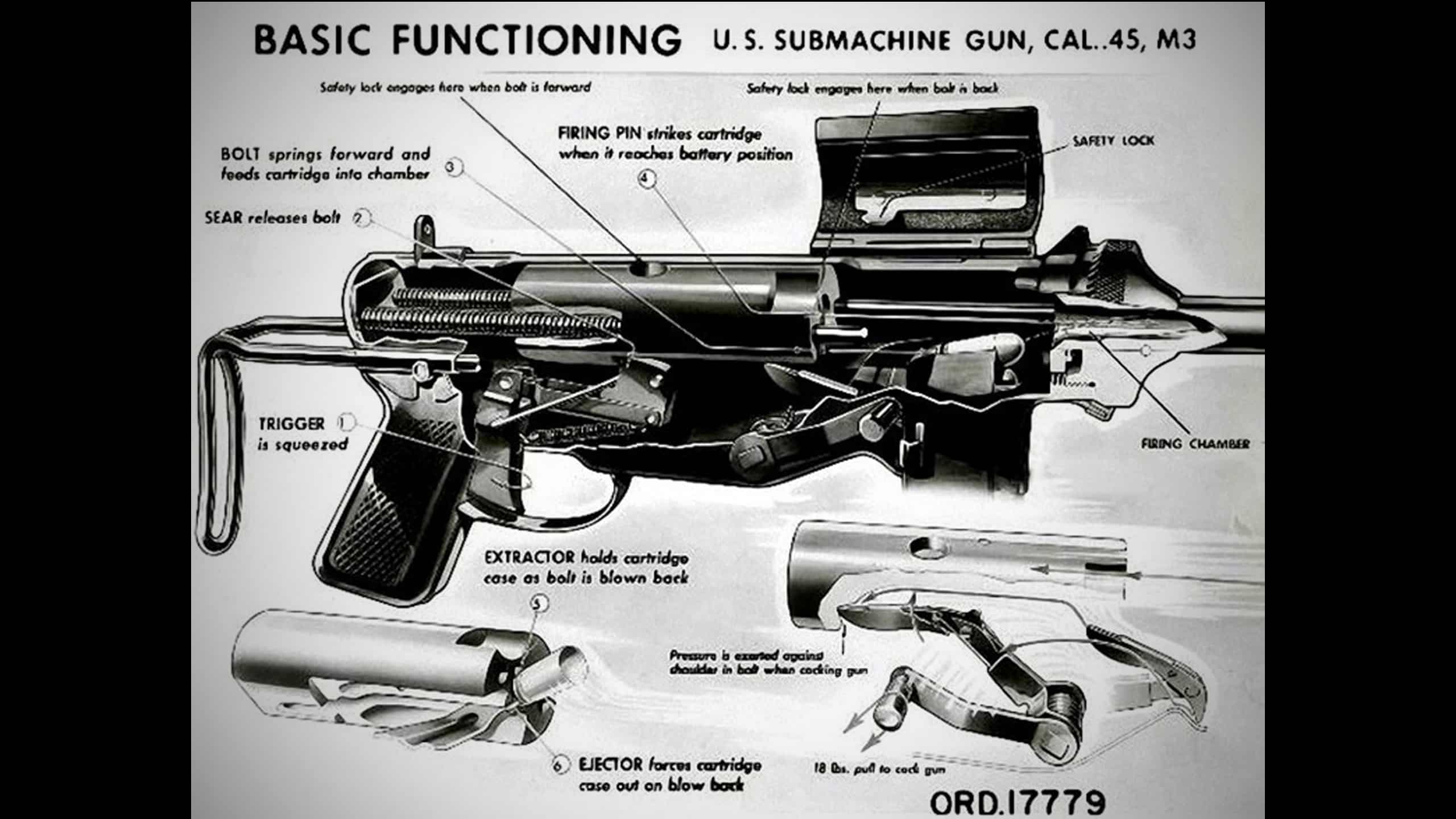
While we might hear the terms “machine gun” and “submachine gun” a lot, a more detailed discussion will often touch on the terms “open bolt” and “closed bolt.” But, what do these terms mean?
The Differences Between Open and Closed Bolts
The difference between a firearm with an open-bolt design versus a closed-bolt design is the position of the bolt prior to firing the gun. On an open-bolt gun, the gun is ready to fire when the bolt is locked open and there is no cartridge in the chamber. When the trigger is pulled, the bolt moved forward and strips a round from the magazine. As the bolt closes, the round is fired and the cycle continues until the trigger is no longer depressed or the gun runs empty. In a closed-bolt design, is it the opposite. The bolt is closed and a round is in the chamber prior to firing the gun. Pulling the trigger drops the hammer, the round is fired, the action is cycled, and this continues until the trigger is released or the magazine is empty.

Examples of a closed-bolt design firearm include the AR-15, the Springfield Armory Hellion, MIA rifles and the Kuna pistol, to name just a few. For examples of open-bolt designs, you really need to look back at submachine guns designed during World War II.

Some of the most common and icon submachine guns during the war were an open-bolt design. The American M3 Grease Gun, British Sten SMG, and the German MP-40 Schmeisser were all open-bolt designs. Also developed during the war was the American M1941 Johnson light machine gun and the German FG 42. These two example are unique because they incorporate an open bolt in full auto and a closed bolt in semi-auto fire.
Open Bolt Design Firing Cycle
Here’s the layman’s explanation of the cycle of operation on an open-bolt design and a closed-bolt design.

To fire an open bolt design, whether a semi-automatic or a full-auto firearm, the first step is to insert a magazine and then retract the bolt. In an open-bolt design, the bolt remains rearward. It is literally open and the firearm is ready to fire. Press the trigger and the sear releases the bolt, driving the bolt forward, pushing a cartridge out of the magazine and into the chamber and firing the cartridge in one swift motion. The bolt then cycles back ejecting the spent case and then moves forward to start the process over.

Live The Armory Life. The latest content straight to your inbox plus an automatic entry to each of our monthly gun giveaways!
In a closed-bolt design, the process is different. Insert a loaded magazine and pull back on the charging handle and release it. The bolt flies forward, strips a cartridge from the magazine and runs a cartridge into the chamber. The bolt is literally closed and ready to fire. Press the trigger and either a hammer is tripped or striker released, which fires the cartridge.
Pros and Cons
In an open-bolt system, as the trigger is pressed to fire the gun the weight and mass of the bolt moves forward, jolting the gun as it slams closed. That movement can interfere with the shooter’s aim. In a submachine, that’s not much of an issue. In a closed-bolt design, the bolt is forward and a press of the trigger releases the hammer or striker, so there is no movement in the bolt prior to firing the shot. A closed bolt design is more conducive to better accuracy.

The advantage of an open-bolt design is realized in full-auto guns. High rates of fire create extreme heat in the chamber and barrel, which can create a dangerous situation called a “cook off.” This is where a cartridge in a heated chamber fires without the trigger being pulled. In an open-bolt design, since the bolt is open and there is no cartridge in the chamber, air cools the chamber and will prevent the risk of a cook-off.

Another advantage of an open-bolt design is that it generally uses fewer parts than a closed bolt design. In an open-bolt design, the firing pin is generally machined as part of the bolt. Because of the inertia caused by the bolt closing when the trigger is pressed, the fixed firing pin strikes the cartridge primer without the need for a hammer and firing pin.

Since open-bolt guns are inexpensive to make and use fewer parts, they were mass produced during WWII. The American M3 Grease Gun for example cost about $20 to produced compared to other submachine guns that cost upwards of $70 at the time. The British Sten gun cost only about $10 to make during the war. Both of these open-bolt design weapons were inexpensive and quick to produce.

Conversely, closed-bolt designs are more complex and expensive, but can fire more accurate shots and are generally more “refined” designs. Examples of full-auto closed bolt designs would be rifles like the M16 and the M14.
Conclusion
So there you go. If you’re reading up on a machine gun design and they reference “open bolt versus closed bolt,” you’ll now understand what it means. Now that you understand the firing sequence, it’s and an open and closed case from there.
Editor’s Note: Be sure to check out The Armory Life Forum, where you can comment about our daily articles, as well as just talk guns and gear. Click the “Go To Forum Thread” link below to jump in!
Join the Discussion
Read the full article here