
I’ve seen long-range shooting referred to as “weaponized math,” and there’s a great deal of truth to that appellation. Whether you hew to milliradians or MOA, there’s math just getting a scope ready to shoot: Torque settings on the mount and on the scope rings, proper leveling of the reticle, making adjustments to zero; there’s a lot of numbers before you even think about “going long.”
Bullet-drop-compensating reticles—reticles whose markings represent a drop at a certain distance for a projectile of known weight and velocity—are one way to mitigate the math needed for long range. Some scopes are calibrated so that each setting corresponds to the yard or meter distance: i.e. number “5” represents 500 yards; dial to “5” to set the scope to be zeroed at that distance. Burris, long known for intricate electronics that assist in long-range shooting with scopes like its laser- rangefinding Eliminator, has upped the game with its new XTR PS.
What the XTR PS does, in a nutshell, is magic (using Arthur C. Clark’s admonition that sufficiently advanced science is indistinguishable from magic). Using a paired app with a built-in ballistic calculator, the XTR PS takes the projectile weight, profile and velocity, figures out its trajectory and sends that information directly to the scope. Once it’s properly configured, all the shooter needs to do is input the distance to the target, and the reticle is instantly spot-on. This is handled through the Programmable Elevation Knob (PEK). Simply turn the PEK until the distance in the display matches the distance to the target, and the reticle will be set for that distance.
Of course, the million-dollar question is whether it works in real life or not. To answer this, I traveled to FTW Ranch in Barksdale, TX, home of the SAAM (Sportsman’s All-Weather, All-Terrain Marksmanship) training facility, which teaches long-range shooting in real-world applications to hunters, elite military units and long-range competitors. The exercise started with zeroing the rifles—impressive Tikka T3x Ace Target and Game versions in 6.5 Creedmoor—at 100 yards. Once the scope was physically zeroed, the app to which the scope is paired takes that input and resets the zero. It’s 100-percent user programmed, in that you can zero at whatever distance you want, with distance increments for the range card also in increments of the user’s choosing. If you want a 100-yard zero and 100-yard increments or a 50-yard zero with 25-yard increments, the software is up to the task. You can also set up multiple profiles for different loads or even different cartridges entirely (assuming you re-mount the scope on a different rifle, of course).
At FTW, I took the equipment from 100 yards out to 1,500 yards. At the extreme edges, right around where the scope was starting to reach the limits of adjustment, it appeared to be slightly low; at every distance closer than 1,500 yards, though, every single time I dialed my scope, the reticle was exactly where it needed to be. Had you told me, 10 years ago, that an off-the-shelf rifle with factory ammo would make a first-round hit at 1,000 yards—with me behind the trigger—I’d have thought you were joking. With the new Burris XTR PS, the only laughing was in delight at making hits.
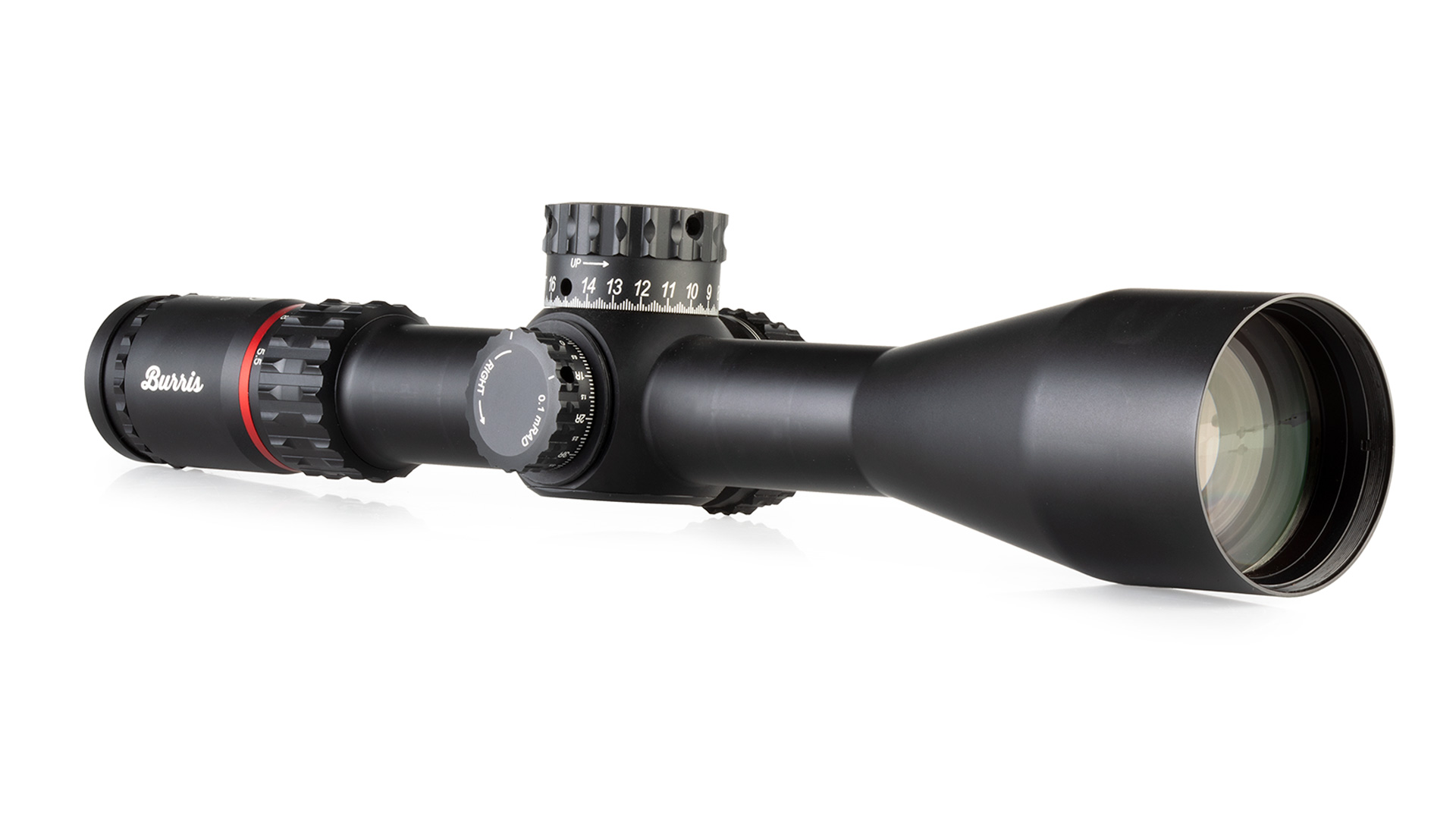
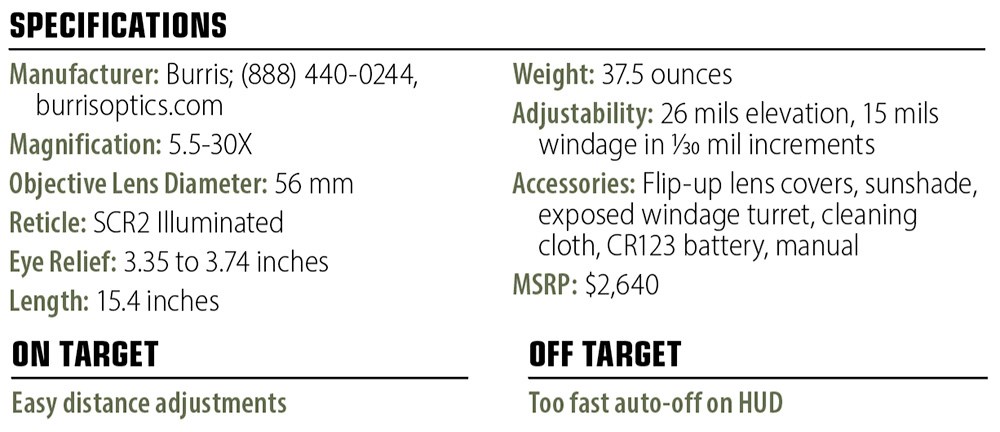
Navigating the heads-up display (HUD) is accomplished via buttons on the parallax-adjustment knob, while power comes from a single CR123 battery • Included with the XTR PS are a sunshade, flip-up lens covers and a separate turret for windage with prominent markings for dialing wind corrections rather than using holdovers • Adjustments are tactile and are made with the ring closest to the eyepiece to focus or farther forward to change magnification • Elevation adjustments can be checked in the HUD within the ocular lens.
Is it perfect? Well, nothing truly is, right? The interface with the app is complicated. It’s not impossible or anything, but great care must be taken so that all data is input in the correct location. That’s not a knock on the scope, mind you; there are seemingly endless variables for which to account when reaching out beyond 500 or 600 yards. The more accurately you can set up the XTR PS, the better it is going to work in the field. The display field is quite busy; in addition to a “Christmas tree” reticle, there’s a heads-up display (HUD) with an electronic level, the distance displayed in yards, meters, mils or MOA, a battery indicator and several other user-programmable functions including a countdown timer for PRS-type shooting. It’s important to remember this is a tool that requires precise input for proper output.
What I want to stress about the XTR PS is that it works. Period. Once you know how far the target is, you spin the PEK until that number appears. The scope is ready to make hits at that distance—done. It doesn’t call the wind for you; that’s on you (and in my case, it’s something upon which I desperately need to improve). With proper wind calls, first-round hits out to 1,200 yards were easily achievable—and I hadn’t shot beyond 100 yards in close to a year at this point. At no distance closer than 1,500 yards did I find the elevation I dialed to be incorrect. Even the misses were left or right of the target; very few fell short or went beyond (hey, I sometimes pull shots; sorry).
I’ll leave this as a final testament to the scope, ammunition and Tikka rifle: On the second day, we started out with confirmation of our zeroes at 100 yards. I spun the turret down to the stop (100-yard zero), practiced a few dry-fire shots, then proceeded to stack three rounds in a triangle at the top of the bullseye. Choosing another target, just to be certain, I put two more rounds side-by-side in the very center, and I am far from the best rifle shooter in the world. Later work at distance revealed the XTR PS to still be ranging exactly where it was expected to be. Really, there’s not much more you can ask for.
Read the full article here