
The Brief:
Virginia Governor Abigail Spanberger signed legislation banning assault weapons and high-capacity magazines effective July 1, 2026. However, Commonwealth’s Attorneys in four counties have announced they will use prosecutorial discretion to decline charges under the new law, arguing that the prohibitions violate constitutional protections for firearm ownership.
State officials maintain that local prosecutors are obligated to uphold state statutes and have warned of potential interventions. While these local non-enforcement policies offer some protection, the Virginia State Police still possess the authority to make arrests and confiscate property regardless of a county’s stance on the ban.
RICHMOND, VA — The legislative ink has barely dried on Governor Abigail Spanberger’s landmark signature of Virginia’s assault weapons ban, but the state’s enforcement architecture is already fracturing along deeply partisan geographic lines.
On Thursday, May 28, 2026, a coalition of local Commonwealth’s Attorneys launched a coordinated act of legal resistance, utilizing prosecutorial discretion to effectively nullify the state’s incoming firearm prohibitions within their respective jurisdictions. The move directly reignites the grassroots “Second Amendment Sanctuary” movement that saw dozens of Virginia municipal boards pass protective resolutions during the previous legislative cycle.
The Standoff: State Mandate vs. Local Discretion
Governor Spanberger signed House Bill 217 and Senate Bill 749 on May 15, outlawing the future manufacture, sale, transport, or import of semi-automatic rifles like the AR-15, alongside magazines holding more than 15 rounds.
While the administration expected legal warfare from national gun rights groups in the courts, the internal mutiny from county prosecutors presents an immediate, ground-level threat to the law’s operational reality.
Virginia Attorney General Jay Jones and the Governor’s office issued joint retaliatory warnings, reminding the defiant prosecutors that they are constitutionally bound to uphold laws passed democratically by the General Assembly. “Elected prosecutors are expected to uphold the rule of law,” the statement noted, hinting at potential state-level interventions or funding challenges if the boycott persists.
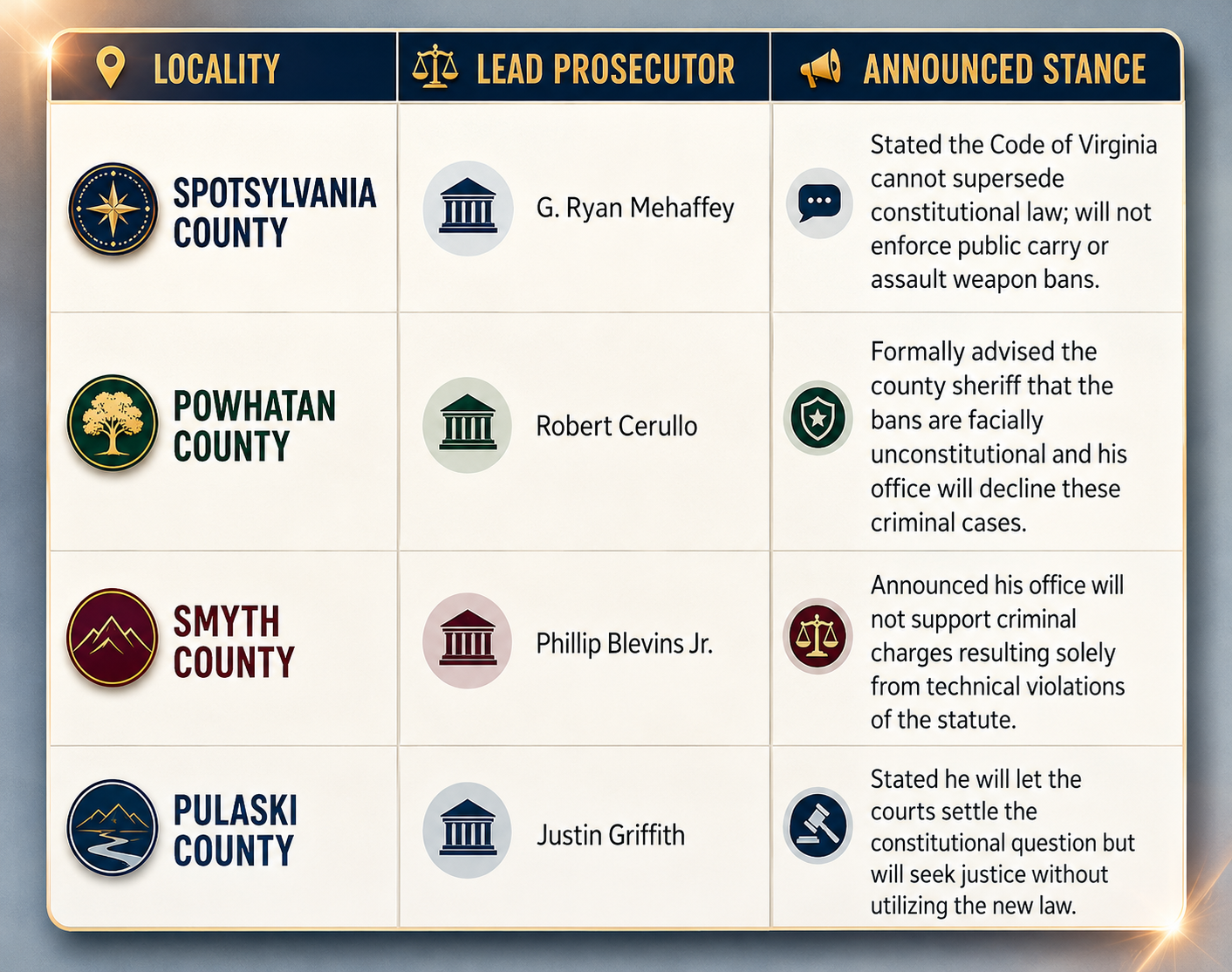
The Defiant Four: Local Enclaves of Non-Enforcement
The specific tactical approaches vary slightly by county, but the net result is identical: technical violations of the ban will not be pursued through local criminal courts.
The Power of Prosecutorial Discretion
This structural rebellion highlights a core operational truth of American jurisprudence: a law on paper is only as powerful as the prosecutor willing to sign the indictment. By explicitly instructing their county sheriffs and police departments that their offices will drop or decline charges under the ban, these prosecutors are insulating local gun owners from state-level felony traps.
The prosecutors’ legal defense rests on the historic principle that their primary oath is to the U.S. and Virginia Constitutions, both of which contain explicit clauses protecting the right of the people to keep and bear arms. If a state statute directly infringes upon that foundational right, they argue, the statute itself is inherently illegitimate.
Safety Tip: While the announcements from these Commonwealth’s Attorneys provide a strong layer of political and localized legal protection, Virginia gun owners must exercise extreme tactical caution. A local prosecutor’s refusal to file charges does not stop the Virginia State Police (VSP) from making an arrest or confiscating your property within that county. The VSP answers directly to the Governor and the Attorney General, not the local county board. If you are detained by a state trooper for possessing a grandfathered or banned item without proper verification, you could still be processed into jail, even if the local prosecutor ultimately throws the case out weeks later. Until the federal and state lawsuits secure a formal, statewide preliminary injunction before July 1, treat the boundaries of these “sanctuary” counties as fluid defensive zones, not absolute legal shields.
Read the full article here