
Most preparedness plans for putting meat on the table start and end with a rifle. That makes sense until the ammunition runs out. Americans watched that happen in 2020 and 2021, when gun stores had empty shelves and a box of common cartridges cost double what it did a year earlier. A rifle also announces your location to everyone within a mile every time you pull the trigger. That can matter a great deal when times are hard and other people are hungry too.
In a world where modern conveniences can quickly disappear in the blink of an eye, the ability to adapt and rely on your survival skills is becoming more apparent by the day. Picture a world plunged into chaos – a world where the comforts of modern civilization are mere memories. In this new landscape, food is scarce, threats lurk everywhere, and the ability to protect oneself and secure food becomes the ultimate currency.
When the grid fails and ammo disappears, a bow still puts food on the table. Which bow to buy, how to maintain it, and how to hunt with it after a collapse.
It’s not a dystopian fantasy; it’s a scenario rooted in history and one that could be the future we are heading towards, thanks to the elites who wish to crash everything into the ground in some great reset fantasy. From natural disasters to societal collapse, numerous events could lead to a world where survival skills mean the difference between life and death.
But why should you learn to shoot a bow and arrow when firearms are readily available?
Nobody here is telling you to sell your guns. We like having options, and we like having backups for our backups. Whether the trigger is a regional disaster, a long economic slide, or the kind of collapse the great-reset crowd keeps openly fantasizing about, the ability to take game quietly with equipment you can maintain and rebuild yourself is worth having. A bow does that, and it keeps working long after the last box of shells is gone.
Archery Is Worth Learning Even If You Already Own Guns
Quiet Food Procurement A bow can take everything from whitetail deer down to rabbits, squirrels, and birds. With a reel and fishing arrows, it can pull carp and gar out of the shallows. The big advantage is noise. A well-tuned compound bow makes about as much sound as a hard hand clap. A deer you miss often doesn’t know where the shot came from, and your neighbors never hear it at all. In a situation where you don’t want attention, that silence is a real advantage.
Arrows You Can Recover and Build Yourself A fired cartridge is gone for good. An arrow that misses or passes cleanly through an animal can often be found, straightened, and shot again. Arrows do break when they hit bone, rocks, or trees, so don’t believe anyone who tells you one dozen arrows will last forever. Still, a bow with spare shafts, fletching, and broadheads stays in service far longer than a rifle with a finite ammo supply. With practice, you can make usable arrows from shoots, feathers, and sinew when the store-bought ones are gone.
A Takedown Bow Packs Small Many recurve bows are takedowns. The limbs come off the riser with a couple of bolts, and the whole bow fits inside a backpack or a bug-out bag. That makes a takedown recurve one of the easiest hunting tools to carry on foot when weight and space are tight. A rifle can’t break down that small, and a compound bow doesn’t come apart at all.
Low Cost to Get Started You don’t need to spend flagship money to get a capable bow. Entry-level takedown recurves and adjustable ready-to-hunt compound packages both cost less than a quality hunting rifle and scope. Arrows are cheap compared to what they do. A half-dozen carbon hunting arrows and a pack of broadheads will run you roughly the price of a couple boxes of premium rifle ammo, and those arrows can be shot hundreds of times in practice.
Fewer Legal Hurdles to Buy One There’s no federal background check to buy a bow, and most retailers will ship one straight to your door. That is a very different experience from buying a firearm. Hunting with a bow is still regulated. You need a license, many states require a bowhunter education course for archery tags, and plenty of towns ban shooting a bow inside city limits. Owning one, practicing on your own land, and keeping one stored for hard times involves far less paperwork than any firearm.
Real Strength Training Drawing a 50- or 60-pound bow dozens of times per session works your back, shoulders, and core in a way few gym machines do. Walking out to pull arrows, again and again, adds more movement than most people get in a day. Survival situations punish people who are out of shape, and archery practice is one of the few ways to build strength while also building a skill that feeds you.
Types of Bows and Which Is Best for Survival
The bow you choose will come down to your body, your budget, and how you plan to carry it. Some people shoot a traditional bow naturally from day one. Others need the sights and let-off of a compound to shoot accurately at all. Here’s how the four common types compare.
Longbow The longbow is the oldest and simplest design: one long stave of wood with a string running from tip to tip. It has almost nothing that can break, and a skilled person can build one from scratch. The trade-offs are serious. Longbows are the slowest of the four types, they’re awkward to carry through brush at nearly six feet long, and shooting one accurately takes a lot of practice because there are no sights.
Recurve A recurve looks like a longbow with limb tips that curve away from the shooter. That curve stores more energy, so a recurve shoots faster than a longbow of the same draw weight and length. Recurves are easy to find because they’re used in Olympic and club competition, and many are takedowns. As with any traditional bow, you hold the full draw weight at full draw, so hunting weights take real upper-body strength.
Compound A compound uses cams, cables, and a pulley system to make the bow easier to hold at full draw and faster when it fires. It’s what most bowhunters use today. The downsides for survival use are that compounds don’t come apart and that they have more parts that can fail. We favor the compound for most people. If you go that route, spend time learning how to service it before you ever need it to work in a bad situation.
Crossbow A crossbow mounts bow limbs on a stock with a trigger, so it aims and shoots much like a rifle. That makes it the fastest type for a beginner to shoot accurately. Crossbows are also heavy, slow to reload, and loaded with mechanical parts: triggers, safeties, cocking devices, and strings that wear quickly. Some models take real strength to cock without a crank. States also treat crossbows differently from vertical bows during archery season, so check your regulations.
Our Picks for Survival: The Recurve and the Compound
I want to reiterate, that when it comes to choosing the right bow, there really is no right or wring answer. It really comes down to one thing — the best weapon is the one that you are proficient with. And on that note, whatever you choose, you are going to need to practice. You cannot pick up a bow and expect to kill anything without extreme luck.
When it comes to selecting a bow for survival, for us, two options stand out: the recurve bow and the compound bow. Each has its unique advantages, making them valuable additions to our survival toolkit.
Recurve Bows A takedown recurve is the choice for anyone who puts portability and simplicity first. With the limbs off, it fits in a pack, and restringing it takes nothing more than a cheap bow-stringer cord. You can change draw weight by buying a new set of limbs instead of a new bow. It has no cams or cables to break, so the only real failure points are the string and the limbs. The price is that you’re holding the full draw weight at full draw, and aiming without sights takes months of practice to get consistent.
Compound Bows A compound is what most hunters actually carry into the woods, and there’s a reason for that. The let-off feature drops the holding weight at full draw by 70 to 90 percent. A 60-pound compound with 75 percent let-off only asks you to hold about 15 pounds while you wait for an animal to step clear. That extra time to aim, combined with sights and a mechanical release, makes a compound much easier to shoot accurately at 30 or 40 yards. The weak point is maintenance: changing a string or cable on most compounds requires a bow press, so buy a portable press and learn to use it now.
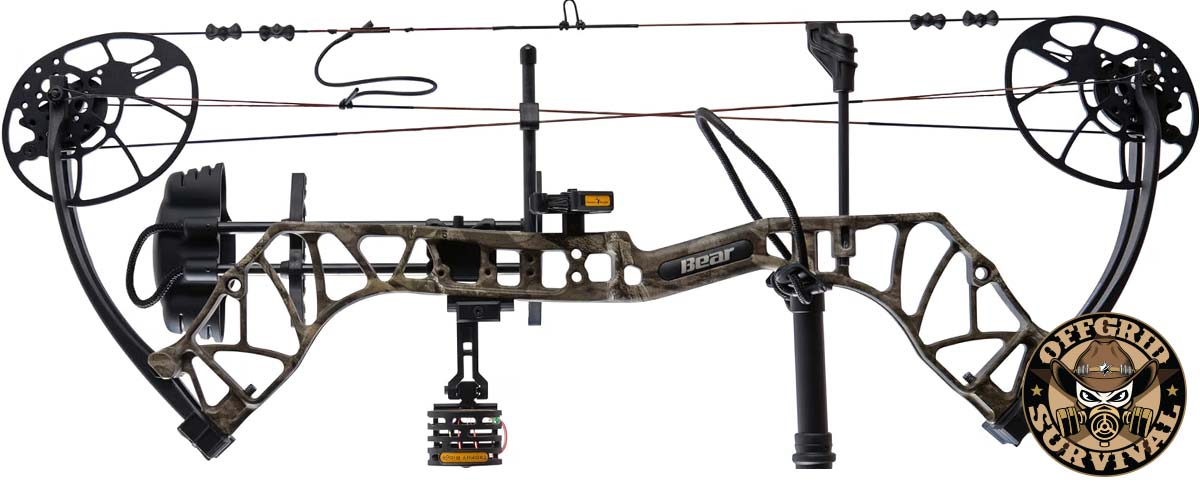
A great all around Compound Bow is the Bear Legit Maxx Ready to Hunt Compound Archery Bow. Draw weight adjusts from 10 to 70 pounds and draw length from 14 to 30 inches, and you can make most of those changes without a bow press. That means one bow can start a kid at 15 pounds, grow with them for years, and still work for a full-grown adult hunting elk. It comes with a sight, rest, quiver, stabilizer, and peep. For a family or a group that wants to share equipment, that range is the whole reason to buy it.
Survival Archery Gear and Field Maintenance
A bow that fails in the field is dead weight, and most failures come from gear nobody inspected. Here’s what to carry and what to watch.
The Bow Check strings and cables for fraying and flat spots, and wax them every few weeks of regular shooting. On a compound, look over the cams and limbs for cracks or splinters after any hard knock. On a recurve, inspect the limb tips where the string sits, because that’s where they fail. Learn how to replace a string and tune your bow yourself instead of relying on a pro shop that may not be open when you need it.
Arrows Buy more than you think you need. Flex every carbon arrow and listen for cracking before you shoot it, because a cracked carbon shaft can shatter and drive splinters into your bow hand. Keep extra nocks, inserts, and fletching on hand, and learn to build arrows from raw shafts so you aren’t stuck when your supply runs low.
Broadheads Most states require hunting broadheads with at least two cutting edges and a cutting diameter of at least 7/8 inch. Fixed-blade heads are simpler and hold up better for survival use than mechanical heads, which have blades and bands that can fail. Carry a broadhead sharpener, because a dull head wounds animals instead of killing them.
Accessories Sights, rests, quivers, and a release aid all make you more accurate. Learn how each one works and how to adjust it. Remember that the skill is in you, not the gear, and practice shooting without sights at least occasionally in case one breaks.
Field Repair Kit Pack a spare string, extra nocks, a set of Allen wrenches, string wax, fletching glue, and a bow-stringer or portable press depending on your bow. It all fits in a pouch smaller than a paperback book, and it keeps a minor problem from taking your bow out of service.
Hunting and Food Procurement with Survival Archery

Hunting with a bow is one of the most useful preparedness skills you can build, and it can save your ass in a long-term collapse. It’s also much harder than hunting with a rifle. Your effective range shrinks from a few hundred yards to about 30 or 40, which means you need to get very close to animals that have spent their whole lives learning to avoid predators. Learn this skill now, while a missed hunt means a trip to the grocery store instead of an empty pot.
Hunting Methods That Work With a Bow
Stalking Stalking means moving slowly into bow range of an animal without being seen, heard, or smelled. Move into the wind, place each foot carefully, and stop often to watch and listen. Wear clothing that breaks up your outline. Stalking is a skill, not something you can just go out and do, and most people spook a lot of animals before they learn how to close the final 50 yards.
Wait and Ambush For most bowhunters, sitting still near a game trail, water source, or feeding area works far better than stalking. Use brush, rocks, or a tree stand for cover, and set up with the wind blowing from the trail toward you. Know your exact distances to landmarks ahead of time so you aren’t guessing when an animal shows up. Patience does most of the work here.
Bowfishing Bowfishing uses a reel mounted on the bow and a heavy barbed arrow tied to line. It works best in clear, shallow water where fish sit near the surface. In most states, bowfishing is limited to rough fish like carp, gar, and suckers, while game fish such as bass and trout are off-limits. In a real emergency, it’s still one of the fastest ways to pull a lot of protein out of a pond.
Know the Animals You Are Hunting
Every species has its own habits, habitat, and vulnerabilities. The more you know about what you’re hunting, the less time you’ll spend walking around empty-handed.
Deer Deer are the main target for most bowhunters because they’re common and a single animal provides a lot of meat. They’re most active at dawn and dusk, and they follow the same trails between bedding and feeding areas day after day. Most states set a minimum draw weight of 35 to 40 pounds for deer, and some Western states require 50 pounds for elk. Check your state’s rules before you hunt, even if you already know your bow is powerful enough.
Small Game Rabbits, squirrels, and birds are ideal survival targets because they’re plentiful and you don’t need to be a great stalker to get close. Use blunt or small-game heads so arrows don’t bury themselves in the ground or disappear into a tree. Learn their feeding and nesting patterns so you know where to look at each time of day.
Fish Carp, catfish, and gar are the classic bowfishing targets. Water refracts light, so fish look higher than they really are, and you have to aim low to hit them. Learning how water clarity, depth, and time of day affect where fish sit takes some practice, but the reward can be dozens of pounds of food from a single afternoon.
Practice Now, Because You Cannot Learn This in a Crisis
A recurve and a compound both have real strengths. The recurve is simple, packs small, and has almost nothing to break. The compound is more accurate and easier to hold at full draw, but it demands more maintenance knowledge. Pick the one that fits your body and your plans, then shoot it several times a week until you can put arrows into a paper plate at 20 yards every time. Build out to 30 and 40 yards after that. A bow sitting in a closet is useless to you when things go bad. A bow you have practiced with for a year, backed by spare arrows, a repair kit, and a clear understanding of how game moves where you live, will put food on your table long after the ammunition runs out.
Read the full article here