
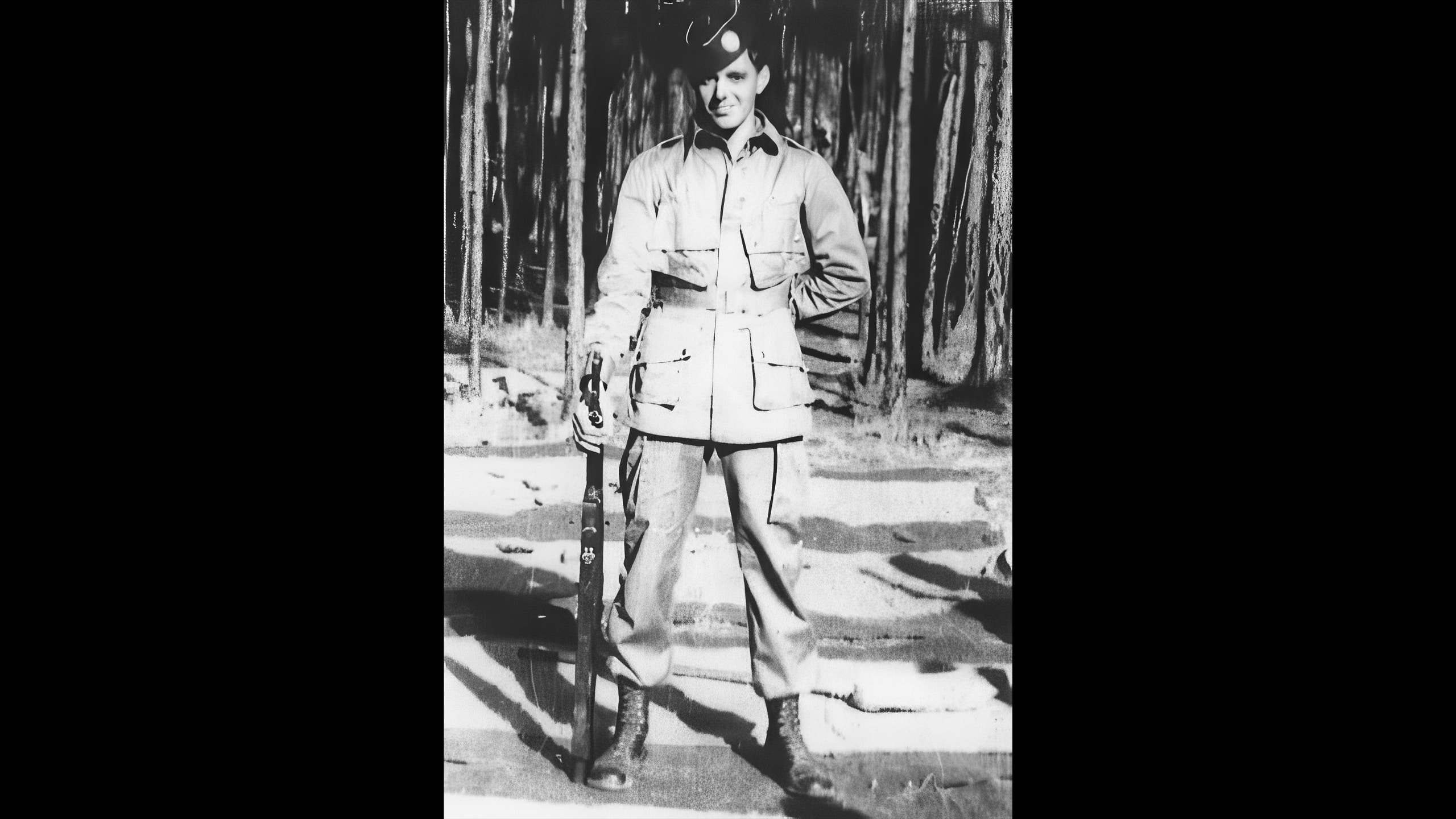
Editor’s Note: Today’s article is about Sgt. Darrell Powers, a World War II hero who served with the 101st Airborne Division. Nicknamed “Shifty”, Powers saw action in the American airborne landings in Normandy, Operation Market Garden and the Battle of the Bulge. Powers was more than “just” a soldier — he was also a gun guy. Ayoob shares the full story here.
Stephen Ambrose’s 1992 book “Band of Brothers” was said to have done as much as Tom Hanks’ 1998 movie “Saving Private Ryan” to remind later American generations of the heroism of our servicemen’s sacrifices for freedom in World War II.
The book was based on the recollections of individual paratroopers of the 101st Airborne Division of the U.S. Army, known as the “Screaming Eagles,” and particularly Easy Company. Tom Hanks and Steven Spielberg made it into a compelling HBO TV series that debuted in 2001. America felt it got to know those brave soldiers.
One of them was Sergeant Darrell “Shifty” Powers. His nickname didn’t carry the word’s usual meaning: he earned it in high school for his fast moves on the basketball court. Tall and athletic, he was also one of us: a “gun guy.” He was a hunter, a marksman and, in later life, an outspoken Second Amendment advocate and a daily concealed carrier for whom shooting was a beloved hobby until his passing at age 86.
A Hunter’s Eye
Powers was born and grew up in the hollows of rural Virginia, spending as much time as he could hunting on a mountain on his family’s property. He shot his first squirrel when he was a little boy. His father taught him to be alert to his surroundings in all ways: a subtle sound, an unexpected silence, and more. It was a skill that would save his life and other lives in combat.

In “Band of Brothers” Ambrose wrote of the day, December 29, 1944, when Easy Company was fighting its way out of the Battle of the Bulge, and Shifty noticed a distant tree that hadn’t been there the day before. Based on his observation, the Americans recognized a newly installed and camouflaged German artillery battery and called in American artillery on it, eliminating the threat.
The Guns of Shifty Powers
In his authorized biography by Marcus Brotherton, “Shifty’s War”, Powers mentioned that as a paratrooper he was issued a 1911 .45 auto with a shoulder holster and wore ten eight-round en-bloc clips of .30-06 on his belt to feed his M1 Garand. Shifty said, “Lot of guys used the carbine, you know, and some guys used Thompsons, but I always liked the M1 Garand best.”
It was a preference that remained throughout his life, even into his eighties when he was suffering macular degeneration and being treated for cancer. He told Brotherton, “Those treatments made me real weak. I liked to get out on the deck and shoot my rifle, you know. Nobody lived very close around our house, so it was okay. I couldn’t see to hit a target very well anymore, but I knew where they were. I didn’t hit them all the time, but I’d fire the gun and smell the smoke, so I’d enjoy that.”

“My M1 was my favorite rifle, but it got hard to lift, you know, and I told (my wife) Dorothy, ‘You know, that doggone rifle has gotten fatter since the war.’ Ammunition for M1’s was hard to come by, but my friends would bring me clips. I had a .22 with a scope, which helped me see the targets, so I’d shoot that every so often. Then I had a Lugar (sic) that I’d shoot, and a .22 pistol that I’d like to shoot. As a last resort I had a BB gun, and I’d take that out on the deck.”
The M1 he used in combat was not entirely stock. Shifty had filed the sear to achieve what he called a hair trigger. It was the rifle he used for his most famous shot of the war. Alas, it didn’t follow him all the way through the war. Stephen Ambrose explains in “Band of Brothers,” “Shifty Powers got a new M1. That was a mixed blessing. He had been using one issued to him in the States. He loved that old rifle. ‘It seemed like I could just point it, and it would hit what I’d pointed it at. The best shooting rifle I ever owned. But every time we’d have an inspection, I’d get gigged because it had a pit in it, in the barrel. You can’t get those pits out of those barrels, you know…’ He got tired of being gigged, turned it in and got a new M1. ‘And I declare, I couldn’t hit a barn with that rifle. Awful’est shooting thing there ever was.’”
“Shifty’s Shot”
That famous shot happened in January of 1945. Fighting their way out of the Battle of the Bulge, Shifty’s unit found themselves in the strategically placed town of Foy in Belgium. (Factoid: while Yanks pronounce that town’s name like it sounds, rhyming with “toy,” those who live there reportedly pronounce it “Fwah.”)
A fellow member of the Band of Brothers, Carwood Lipton, told the story this way: “One of the men in the 3rd platoon of E Company, 506th had excellent eyesight, and he was also an outstanding marksman with a rifle. He was Darrell C. ‘Shifty’ Powers, a tall part-Indian, from Clinchco, Virginia.”

Live The Armory Life. The latest content straight to your inbox plus an automatic entry to each of our monthly gun giveaways!
“Shifty’s marksmanship paid off for us on January 13 when E company received orders to attack and clear the town of Foy. We moved around to the south of the town and attacked to the north into it. The Germans defended it strongly, and we had a number of men hit. At one point, several of us, including Shifty, Popeye Wynn (Shifty’s closest buddy), Bob Mann, R.B. Smith, and I were pinned down by a sniper that we just couldn’t locate. R. B. Smith caught a bullet in the leg. Then Shifty yelled, ‘I see ‘im.’ And there was a rifle shot. We weren’t pinned down any more so we continued the attack.”
“When things had cleared up later that day I went back to see where that sniper had been. When I found him, Popeye had already found him. We stood there looking down at the dead German and at the bullet hole centered in the middle of his forehead. Popeye looked over at me and said, ‘You know, it just doesn’t pay to be shootin’ at Shifty when he’s got a rifle.’”
The buildings the German and Shifty each fired from still stand. One researcher later determined the distance to be 66 meters.

Powers’ own memory of shooting a sniper in Foy differs somewhat. From the “Shifty’s War” book:
“More shots rang out. I glanced up then down again. The other man along the side of the building froze. The sniper kept firing. Our other guy didn’t stand a chance unless we could get that sniper. I ducked up again to get a bead on where the sniper fired from. He was about sixty feet away, shooting from around the corner of a brick building. I ducked down again and propped my M1 up on the window ledge. Seven rounds were left in my clip. I didn’t have time to properly aim. I fired from instinct, seeing in my mind the corner of that building where I guessed the German’s head to be. Blam. Blam. Blam. Blam. The dust flew off the brick at the corner of the building. I fired all seven rounds. No sound came from where the German sniper was. Our man found his feet again and checked the other man on the ground. The first man was dead. But the other was just fine. ‘Okay,’ I said with a nod. I thought maybe I saved that man’s life. It felt good.”
In the heat of infantry combat, when a soldier fires at an enemy and sees him go down, he will often never know whether his target was killed, wounded, or merely ducked. In his later years, writes Brotherton, “Shifty told his son-in-law, Seldon Johnson, that he had killed the specific number of eight men during the war. The specific line Seldon remembers was, ‘I know I killed eight men. It could have been more, but I don’t know for sure. People think they know what killing’s like, but they don’t.’”
Ironic Injury
Powers’ keen observation skills and superb marksmanship helped to make him one of the few men in the unit to get from D-Day almost all the way through the campaign without sustaining a single wound. The day came when he won a lottery to be sent home, and missing his family greatly, he used his prize.

He was in a truck taking him and other soldiers back from the front lines when a drunk driver crashed into the vehicle, killing one trooper and sidelining Shifty with a smashed pelvis and other severe injuries that left him hospitalized for almost a year.
A Vet of the Greatest Generation on 2A
Like many WWII vets, Darrell Powers returned home a staunch advocate of the right to keep and bear arms. While stationed in England prior to the D-Day invasion he had been horrified to see Brits drilling with picks and shovels to fight heavily armed German infantry should they invade, because so few of them privately owned firearms. (Indeed, Americans donated many of their personal guns for use by the British home guard.)
Says his biographer Marcus Brotherton, “Shifty recounted orally on several occasions his memory of seeing the people in Aldbourne practice defending themselves with only garden implements. During some of his public talks after the war, he made a strong case for maintaining the legality of privatized gun ownership in the United States. This issue was about the only time he ever made a public political statement. Shifty believed that citizens had a right to own guns to defend themselves … .”
The battle-hardened vet practiced what he preached when he came home, not only keeping but bearing arms. Shifty told Brotherton that he always carried a .25 auto on his ankle, just in case.
Cancer did what the Nazis could not and took Sergeant Darrell Powers in 2009 at the age of 86. Like so many of The Greatest Generation, this American hero left a legacy of the value of skill at arms and the importance of fighting for freedom.
Please be sure to check out The Armory Life Forum, where you can comment about our daily articles, as well as just talk guns and gear. Click the “Go To Forum Thread” link below to jump in and discuss this article and much more!
Join the Discussion
Read the full article here