
The U.S. Navy’s carrier force is the envy of the world, having earned its stripes in the early, dark days of the Pacific War. One of those that first served during that conflict was the USS Card. As an escort carrier, the USS Card served America for almost 30 years and received three Battle Stars and a Presidential Unit Citation. She was responsible for sinking 11 German U-boats as part of a Hunter-Killer Group. During the Vietnam War, she transported much-needed aircraft and supplies. She also made history as being the only aircraft carrier sunk due to enemy action since World War II.
History of the USS Card
Named for Card Sound in Biscayne Bay, Miami, the USS Card (AVG/ACV/CVE-11) began its service in 1942 as one of 45 Bogue-class escort carriers. These ships carried 24 anti-submarine or fighter aircraft, such as Corsairs, Wildcats or Avengers.

Her first mission was in May 1943, as an escort for convoy UGS-8A, which consisted of troop ships and equipment for the invasion of Sicily. After offloading, the Card returned with the convoy, but now it was given more freedom to hunt subs as long as it could protect the convoy. This was the beginning of the U.S. Navy’s submarine Hunter-Killer Group operations (HKG).

The group was part of the testing and development of the Mark 24 FIDO Air-Dropped acoustic torpedo and the Hedgehog forward-firing depth charge, which was essentially a depth charge mortar. The Hedgehog was fired ahead of the ship to a range of 250 meters, and was equipped with contact fuses that required contact with a hard surface, such as a submarine hull, instead of timed or bathymetric (depth) fuses.
The Hunter-Killer Groups used “Ultra” signals Intelligence provided by Great Britain to track German “Enigma” cipher machines to locate enemy submarines. The Card then launched its submarine-hunter aircraft, which destroyed the subs with their air-dropped FIDO torpedoes. By the war’s end, the Card had racked up 11 German submarines sunk.

After World War II, the Card made a few “Magic Carpet” cruises, transporting troops home from overseas, and in 1946, was placed into the reserve fleet in Norfolk, Virginia.
A Second Life
In the mid-1950s, the Card was returned to the fleet as a helicopter escort carrier, then a utility carrier, and finally, in 1959, as an aviation transport ship with the Military Sea Transportation Service (now Military Sealift Command). As an aviation transport ship, it was designated as USNS Card and operated with a civilian crew.

In the early 1960s, the Card began transporting aircraft and helicopters to Vietnam, and returning them to the U.S. for repairs as the war escalated.
The First Attempt
While few know about the sinking of the Card, even fewer know about the first attempt at sinking a carrier. On December 9, 1963, Lam Son Nau — a South Vietnamese man loyal to the north — was a stevedore at the harbor in Saigon and attempted to sink the USNS Core, a similar-type transport ship.
In Early 1963, Nau joined the Viet Cong (VC) as a commando. As spies tend to do, Nau was always collecting intelligence while at work to hand over to the Viet Cong. Nau recruited two other VC sympathizers and set out to sink the Core using IEDs constructed of U.S.-made C-4 explosive with TNT boosters.

Nau and his men set out on the little canoes used by civilian employees in the harbor through a sewer tunnel that emptied into the harbor. Nao wanted a successful mission, so he measured the tunnel’s height, width, and length to ensure the device would pass through without issue.

Live The Armory Life. The latest content straight to your inbox plus an automatic entry to each of our monthly gun giveaways!
While out in the harbor, they were stopped by a harbor security patrol. They gave them a story about boarding a cargo ship to steal some American-made radios, promising them a few as a bribe on their return. Nao and the accomplices set these charges onto the hull of the Core. When the charges failed, Nao returned to the Core and removed them, discovering the timer batteries had died. This was the first attempt to sink a carrier, and no one aboard the ship even knew about it.

Nao returned to the local VC commander and asked for permission to try again. The commander was impressed that Nao had gotten so close to pulling off the bombing and to returning to retrieve the charges. Nao was encouraged to try again and to destroy a ship at all costs, telling him to conduct the operation before sunrise to lessen the chance of civilian deaths.
Lam Son Nao
In an interview with the U.S. Naval Institute, the VC Commando who sank the Card spoke about the operation.
“When I found out that the Card was coming up the river — this was a ship which was carrying all kinds of airplanes to the country to kill the Vietnamese people — I got extremely mad. But I was able to turn my anger into action when I was given the job of trying to blow the ship up in order to give support to the political struggles of the city population.”
The Successful Attack
On May 2, 1964, Lam Son Nau pulled off a seemingly impossible operation, the sinking of a U.S. aircraft carrier. Once again, Nau and his partner, Hung, bribed the port officers who stopped them. They staged the charges in a canoe inside the sewer tunnel.

At approximately midnight, Nao and Hung began their operation and swam to the Card, which was located near the sewer tunnel, carrying a device. The pair spent about an hour planting the two IEDs on the USNS Card just above the water line near the engine compartment and the bilge. One was constructed with 80 kilos of TNT, while the other was 8 kilos of C-4 explosives. Once the charges were planted, the timers were set at 0245 with a 15-minute delay.
For additional information about the use of tunnels by the Viet Cong, be sure to read Tom Laemlein’s engaging article about U.S. tunnel rats in Vietnam.
The pair swam towards their canoes, then headed to meet the corrupt port security officers, who were awaiting their 2nd bribe. As they approached, the device went off at approximately 0300, blowing a 12-foot-by-3-foot hole through the hull, flooding the engine room, and sending it down 48 feet to the muddy bottom by the dock where it was moored. There is a controversy as to whether or not crew members were killed. Some versions claim five crew members were killed in the explosion, while others say there were zero casualties.

The crew of the Card acted quickly, closing watertight doors and preventing the ship from capsizing. By sunrise, the Card sat aft down. Salvage operations began immediately, and bilge pumps removed water until the Navy brought in a special 6-inch, high-flow discharge pump to dewater the engine room. On May 19, the Card had been raised approximately 48 feet, enabling the crew to tow the ship to Subic Bay, Philippines, for further repairs before heading to Yokosuka, Japan, for complete repairs and an updated, enlarged elevator deck to accommodate larger cargo.
Following the attack, Navy divers, salvage teams, the tugboat USS Tawakoni (ATF-114), and the salvage ship USS Reclaimer (ARS-42) arrived to assist. One of the divers was Roy Boehm, a founding member of the U.S. Navy SEALs. After inspecting the damage, Boehm claims he found the remains of a Hagensen Demolition Pack, a specialized charge invented by Navy “frogman” Lt. Carl Hagensen and used by U.S. Navy Underwater Demolition Teams (UDT) during World War II. It consisted of eight G.I. wool socks filled with 2.5 pounds of C-2 explosive, contained in a satchel. Boehm believed the Hagensen pack was stolen from a South Vietnamese naval unit by a deserter.

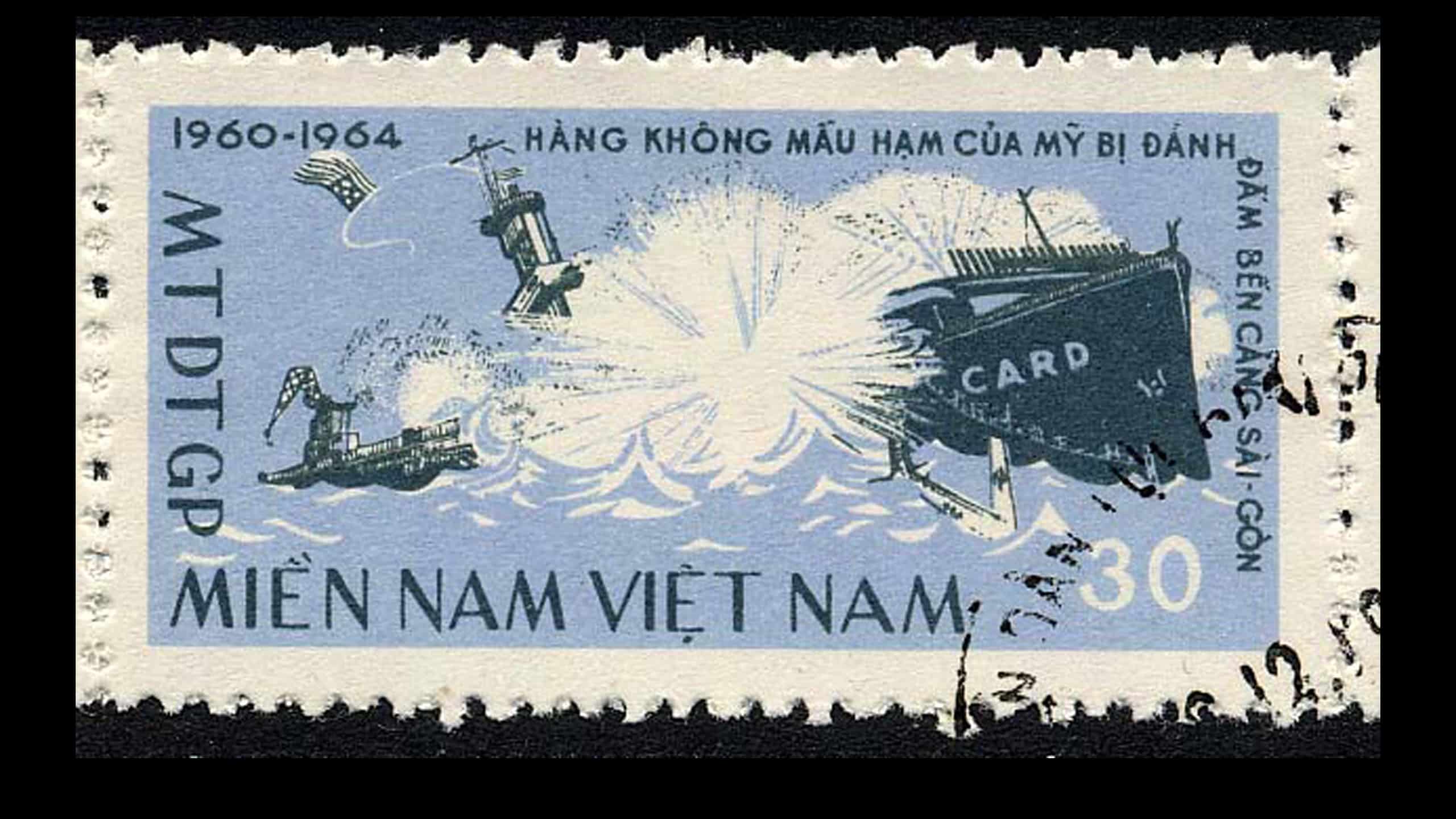
The sinking of the Card was a propaganda dream for the North, which claimed the sinking and total destruction of the Card. On the other side, it was a disaster for the United States. The U.S. didn’t want it known that its ships were this vulnerable, as this would also highlight the pitiful security situation at the civilian-run port and the corruption within the South Vietnamese Government. The U.S. simply reported that the Card was damaged in Saigon. The blackout on the operation prevented the recognition of the outstanding work of the salvage teams, who were able to raise the ship in a mere 17 days.
The North Vietnamese postal service even issued a postage stamp commemorating the sinking. While the U.S. Postal Service did not recognize the stamp, the Canadian postal service had no problem with it.

The Card returned to service in December 1964 and continued its mission of helicopter transport support until March 1970, when it was again placed into the reserve fleet after serving with distinction throughout its service life. Approximately one year later, the Card was withdrawn from the reserve fleet and sold for scrap to the Zidell Explorations Corp. for $93,899.99.
The Legacy
The successful attack on the Card changed port security operations forever, and the attack remains a training example to this day. Lam Son Nau was a revolution-educated citizen whose job was to observe and collect intelligence on American forces. With a simple IED, a Vietnamese commando made history with an early example of asymmetrical warfare.
Editor’s Note: Please be sure to check out The Armory Life Forum, where you can comment about our daily articles, as well as just talk guns and gear. Click the “Go To Forum Thread” link below to jump in and discuss this article and much more!
Join the Discussion
Read the full article here